Criminal Defence & Real Estate Lawyer in Brampton
We’re criminal defence counsel
Speak directly with the lawyer handling your matter, in English, Hindi, Punjabi or Urdu.
Charged, arrested or held for bail?
Criminal defence (416) 305-6019Buying, selling or refinancing?
Real estate (647) 707-4608- LicensedLaw Society of Ontario
- PractisingSince 2021
- LanguagesEnglish, हिन्दी, ਪੰਜਾਬੀ, اردو
- Legal AidCertificates accepted for criminal matters
What is happening right now?
Pick the line closest to your situation. Each one opens a short guide in plain language, with what to do next.
- Criminal defence Police want to talk to me 3 min read
- Criminal defence Someone I know was arrested 4 min read
- Criminal defence I have a court date coming up 3 min read
- Criminal defence I have been charged with an offence 4 min read
- Real estate My offer on a home was accepted 3 min read
- Real estate I am buying my first home 4 min read
Defence when the stakes are highest.
Representation across bail hearings and the full range of criminal offences, from first appearance through to trial.
Every step of a residential transaction.
Legal guidance for buyers and sellers, from the agreement of purchase and sale through closing day.
Focus, not spread.
Direct communication, not a rotating cast of intermediaries.

You speak with the lawyer handling your matter.
Chetanaya Gupta is a criminal defence lawyer who prepares each matter carefully, advocates on his clients’ behalf, and works to protect their rights. Practising since 2021, he represents clients before both the Ontario Court of Justice and the Superior Court of Justice.
Arha Law also acts for buyers and sellers in residential real estate, from the agreement of purchase and sale through closing, and Chetanaya handles those files himself.
- Called to the bar
- Ontario, practising since 2021
- Education
- University of Exeter
- Languages
- English, Hindi, Urdu, Punjabi
- Professional
- Criminal Lawyers’ Association, Indigenous and Diversity Committee
-
Two practice areas, not twelve
Arha Law takes on criminal defence and residential real estate, and nothing else.
-
Direct communication
You speak directly with the lawyer handling your matter. No hand-offs, no go-betweens.
-
Ontario court experience
Representation in Ontario’s courts, built around the realities of how these matters actually move.
Answers before you call.
48 short guides on Ontario criminal law and residential real estate. Most take three or four minutes to read.
Criminal defence
- What are your rights if you're arrested or questioned by police in Ontario?3 min
- What is bail and how does it work in Ontario?4 min
- What happens at your first court date in Ontario?3 min
- Does a charge show up on a background check, and how do you clear a record?3 min
- Should I plead guilty or go to trial in Ontario?4 min
Real estate
- How does a home sale actually work in Ontario, step by step?3 min
- How much are closing costs and land transfer tax when buying a home in Ontario?3 min
- What programs and rebates can first-time home buyers in Ontario get?4 min
- What actually happens on closing day for a home in Ontario?3 min
- Do I actually need a real estate lawyer in Ontario, and what do they do?3 min
One question, about a minute.
Animated explainers made by the firm, with the words on screen and a written version for each. General information, not legal advice.
-
 Length 1:04
Police want to talk. Here's what to say
Police want to talk.
Here's what to say.
If you're arrested or detained: Police must tell you why, and that you can call a lawyer right away. They must also tell you free legal advice is available.
The right to silence: You don't have to answer their questions. Drivers must still show a licence, ownership and insurance.
What to say: “I want to speak to a lawyer.” Say it politely. Then stay silent.
Free legal advice: No lawyer? Duty counsel gives free advice by phone. If you ask, police must give you a real chance to call before questioning.
Good to know: In Canada, your lawyer usually isn't in the room while police question you.
They may keep asking. You can keep saying it.
Remember
- Stay calm. Don't resist.
- Don't lie or give a false name.
- Don't sign what you don't understand.
- Call a criminal lawyer.
-
 Length 1:09
The first 24 hours after an arrest
Someone you love was just arrested.
Here's what the next 24 hours look like.
Hour 0 · Arrest: Police must tell them why, and that they can speak to a lawyer right away. Free advice is available by phone from duty counsel.
At the station: Many people are released from the station, with a promise to come to court.
If they're held: A judge or justice of the peace must see them within 24 hours. Or as soon as one is available.
The bail hearing: It isn't about guilt. It's about risk. Will they come back to court? Is custody needed to protect the public?
Where family comes in: The court may want a surety: someone who supervises them and pledges money. That might be you.
What to do today
- Call a criminal lawyer.
- Find out where they're being held.
- Be ready to come to court with ID and proof of address and income.
- Don't discuss the case on the phone. Calls from custody can be recorded.
If bail is denied: Not released? A higher court can review the decision.
-
 Length 1:05
What really happens at your first court date
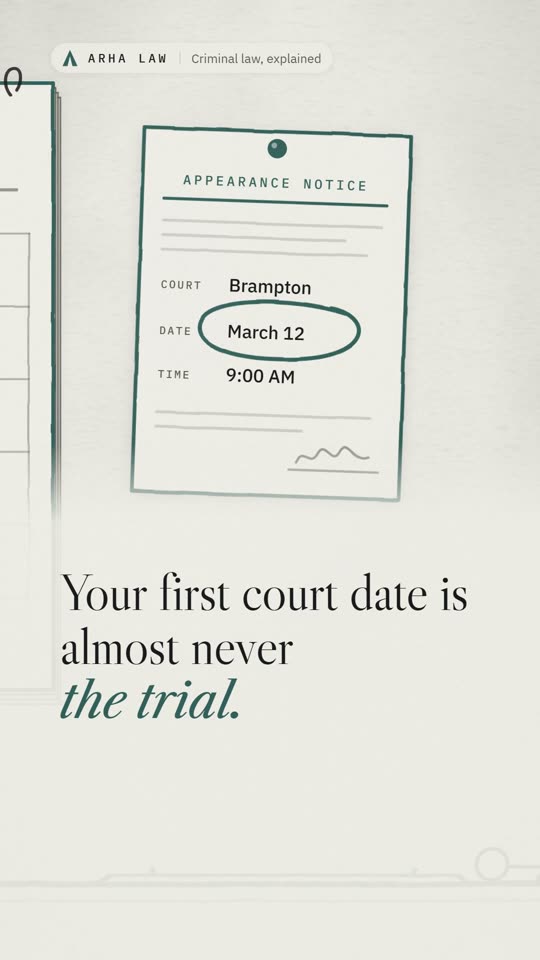
Your first court date is almost never the trial.
Here's what actually happens.
The first date: Your first date is a short appearance in case management court. The court checks on disclosure and whether you have a lawyer.
Disclosure: The Crown, the government's lawyer, must give you its evidence. What helps you, not just what hurts. It's called disclosure. You should get it before you have to plead.
A new date: Then the case goes over to a new date. With a lawyer, that's often about 12 weeks, so the evidence can be reviewed.
Showing up: You still have to attend, in person unless the court allows Zoom. It's the court's call, not yours. Check your release papers.
Getting help: Your lawyer can appear for you, if you sign a designation of counsel. No lawyer yet? Free duty counsel at the courthouse can advise you that day.
It's a first step. Not your trial.
Before you go
- Bring your release papers.
- Arrive at least 30 minutes early.
- Talk to a lawyer before the date.
- Don't miss it. Missing court is its own charge.
-
 Length 1:05
Will a charge show up on a background check?
Charged isn't convicted.
On some checks, it can still show up.
Three checks: Ontario has three kinds of police record check. Each one shows different things. Police can't run one without your written consent.
The basic check: A criminal record check shows convictions. Not charges. It doesn't show discharges either.
The bigger two: The two bigger checks can also show charges still in court, and court orders like a peace bond. Orders tied to a withdrawn charge are left off.
Discharges: A discharge isn't a conviction. But it can show on the bigger two for 1 or 3 years. 1 year if absolute, 3 if conditional. Then it's sealed, with no application needed.
Withdrawn charges: A withdrawn or dismissed charge is left off the first two checks. On a vulnerable sector check, it shows only in rare cases involving children or vulnerable people.
You see it first: The results come to you first. An employer sees them only if you agree in writing. Something you didn't expect? Talk to a lawyer before you share it.
A charge is an accusation. You're still presumed innocent.
Before you share a check
- Ask which check the job needs.
- Read your results first.
- Keep the papers that show how your case ended.
- Talk to a lawyer if something shows up.
-
 Length 1:04
A first impaired driving charge
A RIDE stop. Now it's a criminal charge.
People call it a DUI. The law calls it impaired driving.
At the stop: At any lawful stop, police can demand a breath sample. No suspicion needed. Refusing a lawful demand, without a reasonable excuse, is its own crime.
Two tracks: One stop starts two tracks: your licence, and a criminal charge. Ontario acts on your licence now. The court decides the charge later.
Your licence: Blow 0.08 or more and Ontario suspends your licence for 90 days, on the spot. Plus a 7-day impound and $550 penalty (as of 2026). A court win won't undo it.
If convicted: A first conviction means at least a $1,000 fine and a one-year driving ban. Higher readings raise the minimum to $1,500 or $2,000 (as of 2026).
A record: The minimum penalty rules out a discharge. A conviction means a criminal record. Not a Canadian citizen? It can affect your status. Speak to an immigration lawyer too.
New in 2026: For offences on or after July 1, 2026, an ignition interlock is mandatory after conviction. A breath tester wired into your car. You pay for it.
One stop. Two roads. You don't have to face them alone.
What to do now
- Don't talk about the case, except with your lawyer.
- Keep every paper police gave you.
- Write down the time, the place and any tests.
- Call a lawyer early. Some options have a 90-day window.
Three steps, start to finish.
-
Tell Us What Happened
An initial consultation to understand your situation and what’s at stake.
-
Build the Strategy
We review the facts, the evidence, and the options actually available to you.
-
Move Forward
Advocacy, negotiation, or transaction support, whichever the matter calls for.
Let’s talk about what comes next.
- Office
- 50 Sunny Meadow Blvd, Unit 107
Brampton, ON L6R 0Y7
Get directions (opens in a new tab) - Hours
- Monday to Friday, 9 am to 5 pm
Criminal line answered evenings and weekends - info@arhalaw.com