What happens after you're charged with a crime in Ontario?
After you're charged, police either release you with conditions or hold you for a bail hearing. Your case then moves through court appearances until it ends by withdrawal, a plea, or a trial. Most cases take months, not days.
Dealing with this now? Call (416) 305-6019 or request a consultation
On this page
How does a criminal case start?
A charge starts when police believe they have reasonable grounds to think you committed an offence. You're either arrested on the spot or given a notice to appear later. Being charged is not a conviction. You're presumed innocent unless the Crown (the government lawyer prosecuting the case) proves it in court or you plead guilty.
Read what the video says
Four ways a case can end.
Only one is a conviction.
Withdrawn or stayed: The Crown can withdraw the charge, or stop the case with a stay. Neither is a finding of guilt. A stayed case can restart within a year. After that, it's treated as never started.
Through diversion: Diversion lets some people deal with a charge outside court. Finish it fully, and the charge must be dismissed. You must accept responsibility. What you say to get in can't be used against you.
Peace bond: A peace bond is a court order to keep the peace, for up to 12 months. Not a conviction. Breaking it is a crime. It can show on some deeper police checks.
Discharge: A discharge means you're found guilty, but the law treats you as not convicted. Federal records are sealed after 1 year, or 3 if it's conditional. No application needed.
Conviction: A conviction stays on your criminal record unless you later get a record suspension. It's never automatic. You apply to the Parole Board, and it decides.
Who decides: Which door opens depends on your case, the Crown and the court. No one can promise one. A discharge isn't possible with a minimum penalty. Partner cases: peace bonds only in exceptional cases.
Charged isn't convicted. How it ends still matters.
What to do
- Ask your lawyer which endings are possible for you.
- Know every condition before you agree to anything.
- Follow each condition until it ends.
- No conviction? Ask police to destroy your prints and photos.
Will I be released or held for bail?
Many people are released by police with a signed promise to follow conditions and come back to court. If police decide to hold you instead, you go before a judge for a bail hearing. See our bail page for how that works and what a surety is.
What happens at my first court date?
Your first appearance is usually short. It confirms whether you have a lawyer, and sets a date for disclosure (the Crown's evidence against you) to be handed over. It's rarely where anything is decided. Full details are on our first court date page.
How long does a case take?
It depends on the charge and the court, but most cases take months rather than weeks. Under the Supreme Court of Canada's decision in R. v. Jordan, delay is presumed unreasonable once it passes 18 months from charge to the end of trial for cases tried in the Ontario Court of Justice, or 30 months for cases in the Superior Court of Justice (or tried in the Ontario Court after a preliminary inquiry). Delay caused or waived by the defence doesn't count toward those ceilings, and the Crown can justify going over them in exceptional circumstances, such as a particularly complex case. Passing the ceiling can lead to a stay. For offences since July 18, 2026, a judge must first consider other remedies. Most cases resolve well before that point.
How does a case end?
There are several possible outcomes, and no lawyer can promise one: the Crown withdraws the charge, you resolve it without a conviction through diversion or a peace bond, you plead guilty, or the case goes to trial and a judge (or judge and jury) decides whether the Crown has proven it.
A conviction can also affect someone who isn't a Canadian citizen, including permanent residents. If that applies to you, speak to an immigration lawyer as well as a criminal lawyer.
Watch more on this topic
-
 Length 1:05
What really happens at your first court date
Length 1:05
What really happens at your first court date
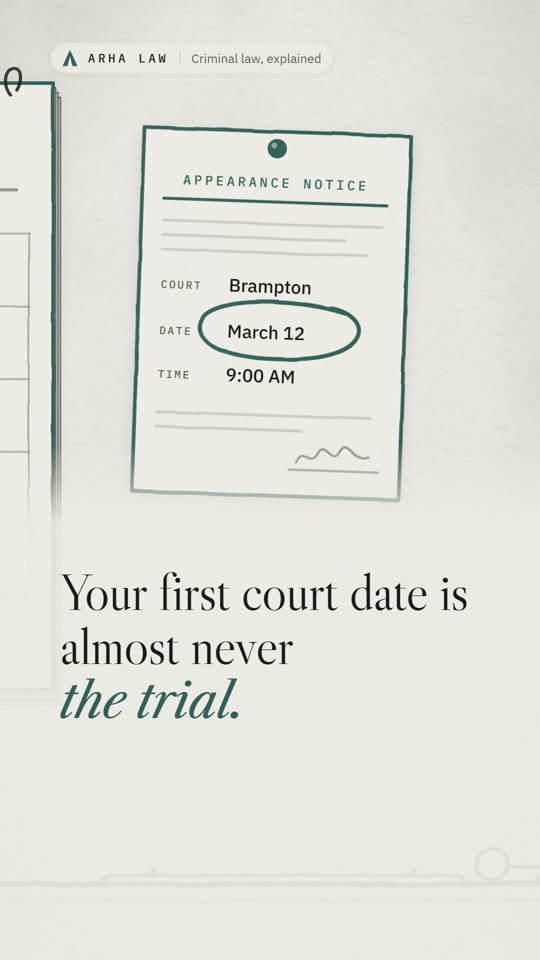
Your first court date is almost never the trial.
Here's what actually happens.
The first date: Your first date is a short appearance in case management court. The court checks on disclosure and whether you have a lawyer.
Disclosure: The Crown, the government's lawyer, must give you its evidence. What helps you, not just what hurts. It's called disclosure. You should get it before you have to plead.
A new date: Then the case goes over to a new date. With a lawyer, that's often about 12 weeks, so the evidence can be reviewed.
Showing up: You still have to attend, in person unless the court allows Zoom. It's the court's call, not yours. Check your release papers.
Getting help: Your lawyer can appear for you, if you sign a designation of counsel. No lawyer yet? Free duty counsel at the courthouse can advise you that day.
It's a first step. Not your trial.
Before you go
- Bring your release papers.
- Arrive at least 30 minutes early.
- Talk to a lawyer before the date.
- Don't miss it. Missing court is its own charge.
-
 Length 0:30
Does Legal Aid cover your charge?
Length 0:30
Does Legal Aid cover your charge?
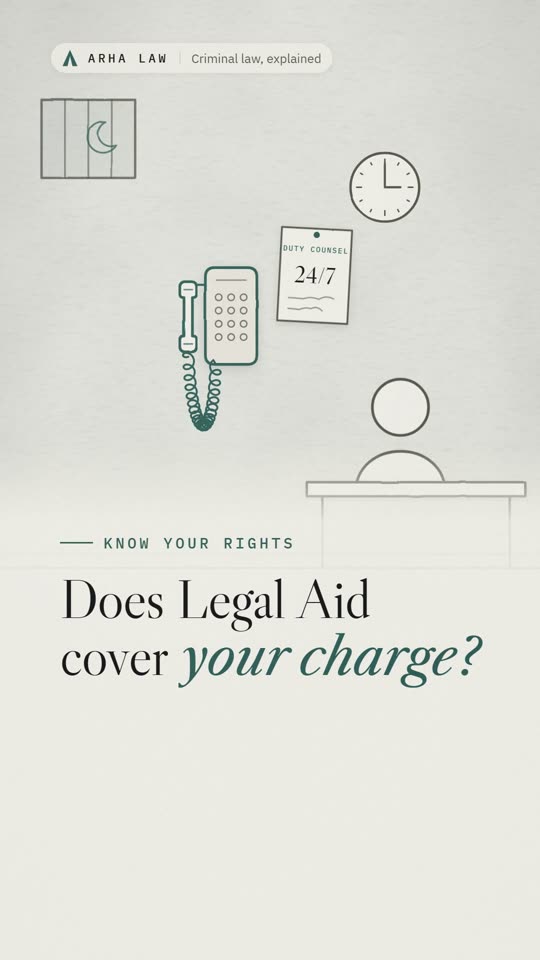
Know your rights: Does Legal Aid cover your charge?
It might. Some help is free. The rest depends.
Arrested or detained: Duty counsel gives free legal advice by phone, 24/7. For everyone, whether or not you qualify for Legal Aid.
Bail: Legal Aid's bail help has no income test. Duty counsel are Legal Aid lawyers at court. Speak to one at your first appearance.
A lawyer for your case: A Legal Aid certificate pays a lawyer, usually when jail is likely if you're found guilty. As of 2026: gross family income under $45,440 for up to 4 people. Assets under $15,000.
What to do: Arha Law accepts Legal Aid certificates. Not sure you qualify? Call Legal Aid Ontario at 1-800-668-8258.
Where to go from here
- Get legal advice before your first court date if you can. Duty counsel at the courthouse may be able to help that day, subject to Legal Aid Ontario's eligibility rules.
- Don't discuss the details of your charge with anyone except your lawyer, including on social media.
- Keep every document police or the court give you, including your release form.
People also ask
Do I have to go to my first court date myself?
Sometimes your lawyer can attend for you, but confirm this first. Some charges legally require you to be there in person.
What is disclosure?
The evidence the Crown has against you: police notes, witness statements, video, and more. You're entitled to see it before deciding how to proceed.
Can a charge be dropped before trial?
Yes, the Crown can withdraw a charge at any point, but this is never guaranteed.
Will this show up on a background check?
A charge alone can show up on some background checks even without a conviction. See our criminal records page.
Sources
This page is general information about Ontario law as of September 2026. It isn't legal advice about your situation.