Drug Charges in Ontario: Possession, Trafficking, and Production
Drug charges come from the Controlled Drugs and Substances Act, a separate law from the Criminal Code. Holding a substance versus selling it changes how serious the charge is. In 2022, Parliament repealed the mandatory minimum jail sentences under the Controlled Drugs and Substances Act.
Dealing with this now? Call (416) 305-6019 or request a consultation
On this page
What's the difference between possession, trafficking, and production?
- Simple possession: having a controlled substance for yourself, no intent to sell.
- Trafficking: selling, giving, or offering to sell, or holding a substance with intent to do so. Treated far more seriously than possession, even for a small quantity, if the evidence points to intent to sell.
- Production: making or growing a controlled substance, including growing cannabis beyond legal limits or running a lab.
Read what the video says
Sharing can be trafficking. The law says so.
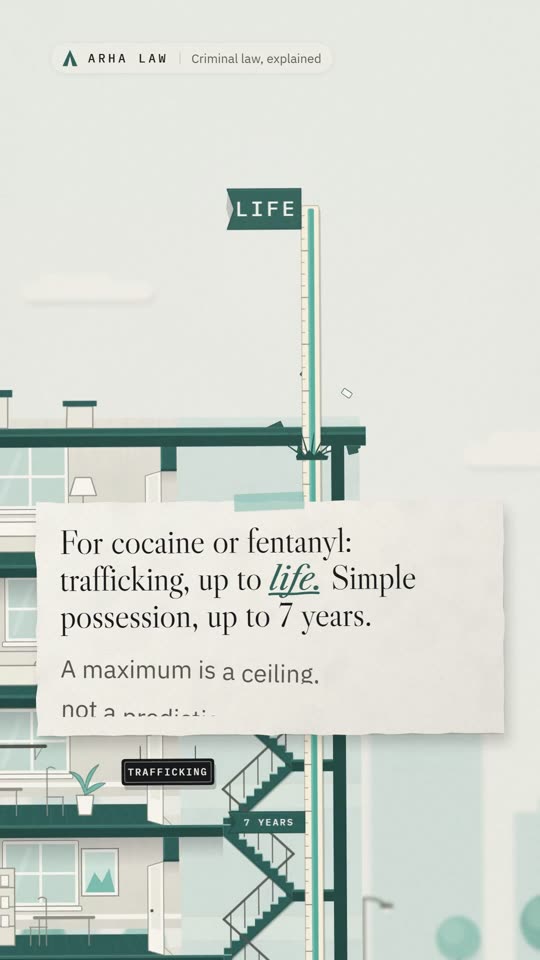
Having it: Simple possession is an offence. For cocaine or fentanyl: up to 7 years. A maximum is a ceiling, not a prediction.
The word “traffic”: In the drug law, traffic means more than selling. It includes giving, transferring and delivering.
Sharing: Handing a friend a drug, free, can be trafficking. For cocaine or fentanyl: up to life.
No mandatory minimums: Parliament repealed the mandatory minimum jail terms in the drug law in 2022. That is not the same as no jail.
Simple possession: For simple possession, police must consider a warning or a referral. That’s a duty to consider. It’s not a right to one.
Calling for help: Calling 911 for an overdose protects you from simple possession charges. It doesn’t cover trafficking.
Having it. Passing it on. Two different charges.
What to do now
- Charged? Get legal advice before your first court date.
- Note your court date and keep every paper.
- Not a citizen? Ask an immigration lawyer too.
- Someone needs help? Call 911.
How are penalties decided?
Substances are sorted into schedules, and the schedule sets the maximum. Possession of a Schedule I substance, such as heroin, cocaine, or fentanyl, tops out at 7 years for a serious case. Trafficking in a Schedule I or II substance can reach life imprisonment, though actual sentences usually land far below that. Parliament repealed the mandatory minimum jail sentences under the Controlled Drugs and Substances Act in 2022, so the sentence depends on the offence, the substance, and the circumstances.
What does the Crown have to prove, and is cannabis still a crime?
For possession, the Crown must prove you knew you had the substance, knew what it was, and had some control over it. Being physically near someone else's drugs isn't enough. For trafficking, it also has to prove intent to sell, often argued from packaging, scales, or cash. Cannabis is legal for adults, 19 and older in Ontario, who can carry up to 30 grams of dried cannabis, or its equivalent, in public. Going over that limit, holding illicit cannabis, or selling outside the legal retail system are still crimes.
What can happen after a drug charge?
Outcomes range from the charge being withdrawn or diverted, to a discharge, to probation, to jail, depending on the substance, quantity, and your record. Drug convictions, especially trafficking, are treated seriously under U.S. immigration law and can lead to being refused entry, sometimes indefinitely unless a U.S. entry waiver is granted. Anyone here on a visa, permit, or permanent residency should ask an immigration lawyer how a drug charge might affect their status too.
Watch more on this topic
-
 Length 0:33
Is sharing a drug trafficking?
Length 0:33
Is sharing a drug trafficking?
Myth or fact?: Sharing can be trafficking. The law says so.
In the drug law, traffic means more than selling.
It includes giving, transferring and delivering. Handing a friend something, free, can count.
For cocaine or fentanyl: trafficking, up to life. Simple possession, up to 7 years. A maximum is a ceiling, not a prediction.
Since 2022, the drug law has no mandatory minimum jail terms.
What to do
- Charged? Talk to a lawyer about your case.
- Not a citizen? Ask an immigration lawyer too.
-
 Length 0:34
Mostly myth: "If I call 911 for an overdose, I'll be charged"
Length 0:34
Mostly myth: "If I call 911 for an overdose, I'll be charged"
Myth or fact: “If I call 911 for an overdose, I'll be charged for the drugs.”
There's a Good Samaritan rule. It has limits.
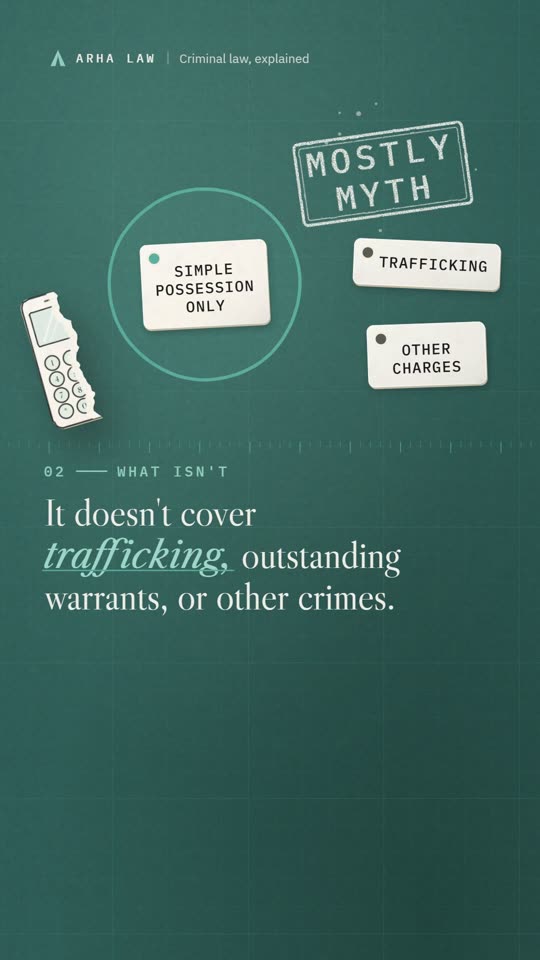
What's covered: Seeking help for an overdose protects you from a simple possession charge. That includes the person who overdosed.
What isn't: It doesn't cover trafficking, outstanding warrants, or other crimes.
Some conditions: Some bail and probation conditions about simple possession count as not broken. Only conditions tied to simple possession.
Mostly myth.
What to do
- Someone overdosing? Call 911.
- Worried about a charge? Ask a lawyer about your own case.
Where to go from here
- Don't discuss your charge with anyone besides your lawyer, including on social media.
- Write down exactly what happened when you were searched or arrested, while it's fresh.
- Read your release conditions closely. Many include testing or reporting terms.
People also ask
Can I be charged with trafficking for a small amount of drugs?
Yes. Trafficking turns on intent to sell, not just quantity, though a larger amount can support intent.
Will a first-time simple possession charge give me a record?
Not necessarily. For simple possession, the law tells police to consider a warning or a referral to a program instead of a charge, and prosecutors can only go ahead if those wouldn't be appropriate. A discharge is also possible. None of these is guaranteed.
What if drugs are found in a shared car or house?
The Crown has to prove you personally knew about the drugs and had some control over them, not just that they were nearby.
Sources
- Controlled Drugs and Substances Act, ss. 4, 5, 7 (laws-lois.justice.gc.ca)
- Controlled Drugs and Substances Act, ss. 10.1 to 10.3, evidence-based diversion measures, Justice Laws
- Public Prosecution Service of Canada Deskbook, 5.13 Prosecution of Possession of Controlled Substances (Aug 17, 2020)
- Cannabis Act (laws-lois.justice.gc.ca)
- Bill C-5, An Act to amend the Criminal Code and the Controlled Drugs and Substances Act, Legislative Summary (lop.parl.ca)
- Justice Canada, "Mandatory Minimum Penalties to be Repealed" (canada.ca)
This page is general information about Ontario law as of September 2026. It isn't legal advice about your situation.