What happens at your first court date in Ontario?
Your first court date is usually short and administrative. It's mainly used to confirm you have a lawyer, get a copy of the disclosure, and set a date for the next step. It's rarely where your case is decided.
Dealing with this now? Call (416) 305-6019 or request a consultation
On this page
Do I have to go in person?
Yes, by default, unless your lawyer has arranged to appear for you instead. If the court allows it, you can appear by Zoom. Check your paperwork, since missing a required court date can lead to a warrant for your arrest.
Read what the video says
Your first court date is almost never the trial.
Here's what actually happens.
The first date: Your first date is a short appearance in case management court. The court checks on disclosure and whether you have a lawyer.
Disclosure: The Crown, the government's lawyer, must give you its evidence. What helps you, not just what hurts. It's called disclosure. You should get it before you have to plead.
A new date: Then the case goes over to a new date. With a lawyer, that's often about 12 weeks, so the evidence can be reviewed.
Showing up: You still have to attend, in person unless the court allows Zoom. It's the court's call, not yours. Check your release papers.
Getting help: Your lawyer can appear for you, if you sign a designation of counsel. No lawyer yet? Free duty counsel at the courthouse can advise you that day.
It's a first step. Not your trial.
Before you go
- Bring your release papers.
- Arrive at least 30 minutes early.
- Talk to a lawyer before the date.
- Don't miss it. Missing court is its own charge.
What actually happens at the first appearance?
For most charges, it's quick: a few minutes in front of a judge. The court confirms your name and charge, asks whether you have a lawyer, and sets a date for you to receive disclosure, the Crown's evidence against you, if it isn't ready yet. It's not where you enter a plea or argue your case.
What is disclosure, and do I get it automatically?
Disclosure is the material the Crown and police have gathered: officer notes, witness statements, video, and anything else relevant to the charge. The Crown has a constitutional duty to disclose all relevant information that isn't privileged, whether it helps or hurts its case. In practice, initial disclosure is usually provided at or soon after the first appearance, often electronically, and more arrives as the case goes on. Your lawyer follows up on anything missing. Review it carefully with a lawyer before deciding how to proceed.
Can I get a lawyer at the courthouse the same day?
Yes. Duty counsel, a free legal aid lawyer, is available at Ontario courthouses on a walk-in basis for same-day advice, and can sometimes appear for you at a first appearance. Some duty counsel services depend on meeting Legal Aid Ontario's financial eligibility guidelines, so ask what help is available to you.
What if I need more time?
It's common for the first date to be pushed to a later date, especially while disclosure is being prepared or you're still arranging a lawyer. A delay like this isn't a bad sign on its own.
Watch more on this topic
-
 Length 0:31
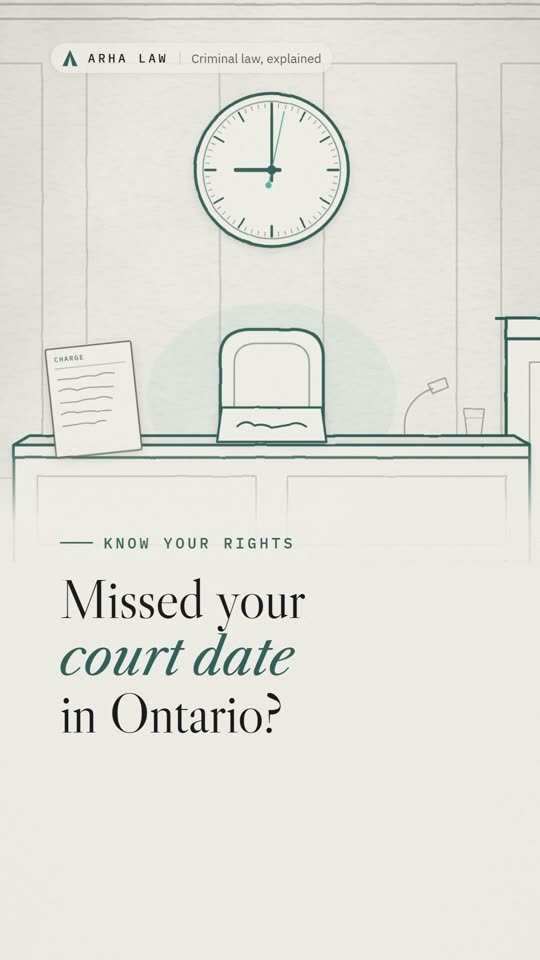
Missed your court date?
Length 0:31
Missed your court date?
Know your rights: Missed your court date in Ontario?
Act today. Don't wait to be arrested.
A new charge: Missing court is its own crime, on top of your original charge. Up to two years. Missing a fingerprint date is a crime too.
A warrant: A judge can issue a warrant for your arrest. It can be used anywhere in Ontario.
Your bail: Your bail can be cancelled. Then it's on you to show why you should be released. Since July 15, 2026, you must clearly show your release plan addresses the risks.
What to do: Call your lawyer, or the court office, right away. A lawful excuse can be a defence.
-
 Length 0:30
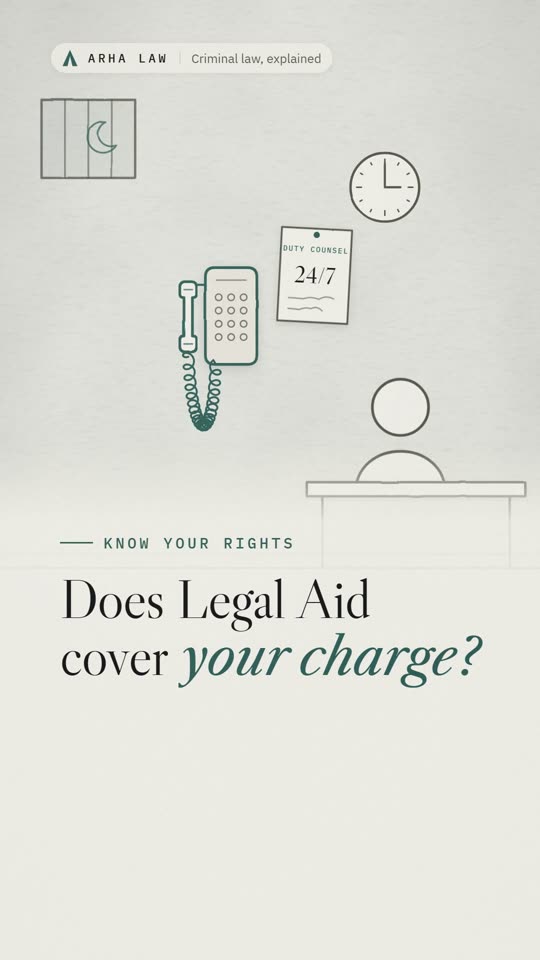
Does Legal Aid cover your charge?
Length 0:30
Does Legal Aid cover your charge?
Know your rights: Does Legal Aid cover your charge?
It might. Some help is free. The rest depends.
Arrested or detained: Duty counsel gives free legal advice by phone, 24/7. For everyone, whether or not you qualify for Legal Aid.
Bail: Legal Aid's bail help has no income test. Duty counsel are Legal Aid lawyers at court. Speak to one at your first appearance.
A lawyer for your case: A Legal Aid certificate pays a lawyer, usually when jail is likely if you're found guilty. As of 2026: gross family income under $45,440 for up to 4 people. Assets under $15,000.
What to do: Arha Law accepts Legal Aid certificates. Not sure you qualify? Call Legal Aid Ontario at 1-800-668-8258.
-
 Length 0:30
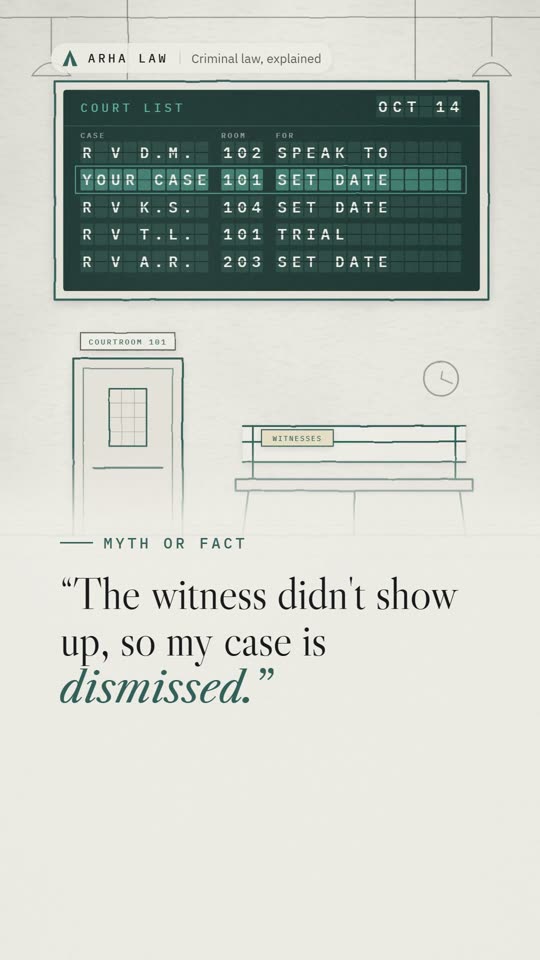
Myth: "The witness didn't show up, so my case is dismissed"
Length 0:30
Myth: "The witness didn't show up, so my case is dismissed"
Myth or fact: “The witness didn't show up, so my case is dismissed.”
Myth. Early dates don't need the witnesses.
Early dates: Early court dates aren't trials. No one gives evidence there. So witnesses aren't expected there. They testify at trial.
At trial: Witnesses, police included, can be ordered to come by subpoena, and must stay until excused. A trial date is expected to go ahead unless a judge allows an adjournment.
If one is missing: The Crown can ask for more time. A judge decides.
What to do: Go to every court date unless your lawyer or the court says otherwise.
Where to go from here
- Bring your release paperwork and any documents police gave you.
- Arrive early. Courthouse security and finding the right courtroom takes time.
- Talk to duty counsel if you don't yet have a lawyer, even just for guidance on the day.
- Don't discuss the facts of your case with anyone in the courthouse hallway, including the other side.
People also ask
Where is my case being heard in the Brampton area?
Most Peel Region criminal matters are heard at the A. Grenville and William Davis Courthouse, 7755 Hurontario St, Brampton, which houses both the Ontario Court of Justice and the Superior Court of Justice.
What should I wear to court?
Dress neatly and conservatively. You don't need a suit, but avoid slogans, hats, or anything overly casual.
What happens if I miss my court date?
The court can issue a warrant for your arrest, and it can also count as a separate offence on top of your original charge.
Can my case be resolved at the first appearance?
It's unusual, but possible for very minor matters where the Crown and defence have already agreed on an outcome.
Sources
This page is general information about Ontario law as of September 2026. It isn't legal advice about your situation.