Should I plead guilty or go to trial in Ontario?
Pleading guilty means admitting, in open court, that you did what's alleged and understanding what follows. Going to trial means making the Crown prove the charge beyond a reasonable doubt. Neither choice is automatic, and it's always your decision, made with legal advice and only after you've seen the disclosure.
Dealing with this now? Call (416) 305-6019 or request a consultation
On this page
What does pleading guilty actually mean?
It's more than saying a word in court. Under the Criminal Code, a judge can accept a guilty plea only if satisfied that it's voluntary, that you understand you're admitting the essential elements of the offence, that you understand the nature and consequences of the plea, that you know the judge isn't bound by any deal between you and the Crown, and that the facts support the charge. A plea entered without understanding what it means can sometimes be struck later, but that's a hard and uncertain process, not a safety net.
Read what the video says
Plead guilty, or go to trial?
It isn't a gut call.
First, the evidence: Start with the disclosure: the evidence the Crown has given your lawyer. It includes what helps you, not just what hurts.
Your lawyer's read: Go through all of it with your lawyer. The decision is still yours. What's strong, what's weak, and what's missing.
If you go to trial: You're presumed innocent. The Crown must prove the charge beyond a reasonable doubt. You don't have to prove anything, or testify.
If you plead guilty: A guilty plea admits every part of the charge. It must be voluntary and informed. The judge must be satisfied you understand what follows.
Resolution discussions: Your lawyer and the Crown may agree on a sentence to suggest. The judge isn't bound by it. Judges rarely reject a joint position. The bar is very high.
Immigration: If you're not a citizen, a guilty plea can cost you your status and lead to removal. Speak to an immigration lawyer before you plead, not after.
A plea is hard to take back. Decide with all of it.
Ask your lawyer
- What does the disclosure show, and what's missing?
- What would the Crown have to prove at trial?
- What follows from a guilty plea in my case?
- Could this affect my immigration status?
What is a joint submission?
Often your lawyer and the Crown discuss a joint submission: an agreed recommendation on sentence in exchange for a guilty plea. The judge isn't legally bound to accept it, but the bar for rejecting one is high. The Supreme Court of Canada has said a judge should depart from a joint submission only if it would bring the administration of justice into disrepute or is otherwise contrary to the public interest. A judge who is thinking of rejecting one has to tell both sides and let them respond first.
What happens if I go to trial instead?
At trial, the Crown has to prove every element of the charge beyond a reasonable doubt; you don't have to prove anything, and you don't have to testify. Most criminal trials in Ontario start in the Ontario Court of Justice, where a judge alone decides the case. For more serious (indictable) charges, you may have the right to an election: choosing trial by a provincial court judge, a judge alone in the Superior Court, or judge and jury, each with different timelines. See our page on disclosure and Crown pre-trials for what happens before you get to this point.
What actually follows a guilty plea?
A conviction can mean a criminal record, and it affects more than the sentence itself: travel to some countries, including the United States, can become harder, and some jobs and volunteer roles that require a background check may be affected. For non-citizens, a conviction can also have immigration consequences, including in some cases affecting status or admissibility. That usually means a conviction for an offence with a maximum of 10 years or more, or a jail sentence of more than six months; for a permanent resident, a jail term of six months or more can also end the right to appeal a removal order. If you're not a Canadian citizen, speak to an immigration lawyer before you plead, not after. Some outcomes, like a discharge or a peace bond, avoid a formal conviction. That can matter for immigration, but get immigration advice before you count on it; see our pages on sentencing and peace bonds and diversion.
Who actually makes this decision?
You do. A lawyer can explain the evidence, the likely range of outcomes, and the risks of each path, but the decision belongs to you alone. Don't let anyone rush you into it, and don't decide before your lawyer has reviewed the full disclosure in your case.
Watch more on this topic
-
 Length 1:03
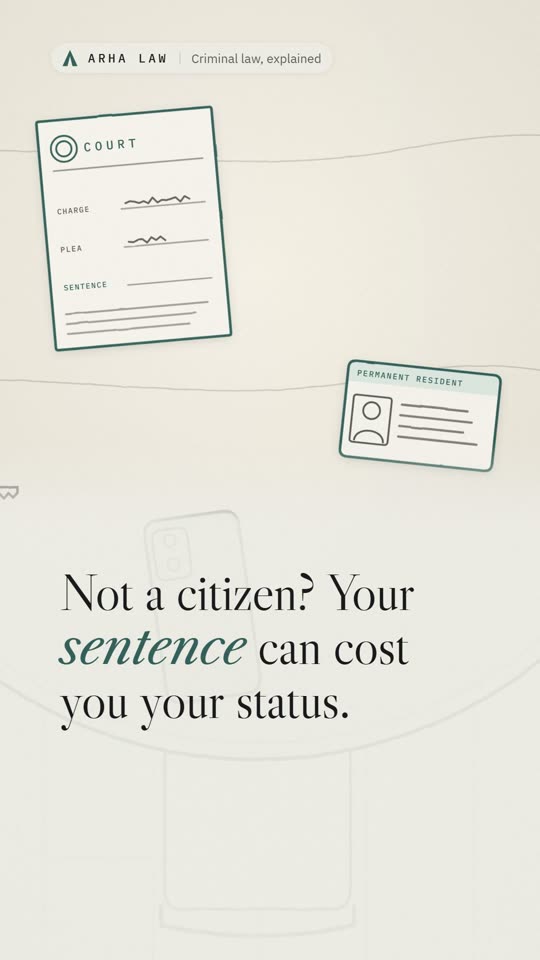
Not a citizen? Your sentence can cost you your status
Length 1:03
Not a citizen? Your sentence can cost you your status
Not a citizen? Your sentence can cost you your status.
It's not the charge. It's the conviction, and the sentence, that count.
Who this is for: This is for permanent residents, students, workers and visitors. Not citizens. Citizens can't lose their status over a crime.
What counts: A conviction, plus the sentence a judge gives you. A 10-year maximum, or more than six months in jail.
The appeal: Six months or more in jail can also take away a permanent resident's appeal. No chance to ask to stay for family or hardship.
A lower bar: Students, workers and visitors face a lower bar. One conviction can be enough. Even a lesser hybrid charge counts as indictable.
Before you decide: A discharge isn't a conviction. But don't count on that without advice. A judge can weigh your status at sentencing. The sentence still has to fit the crime.
There's no promise either way. Only a choice to ask before you decide.
What to do
- Tell your criminal lawyer you're not a citizen, on day one.
- See an immigration lawyer before you plead.
- Don't sign anything about your status without advice.
- Keep every paper the court gives you.
-
 Length 0:31
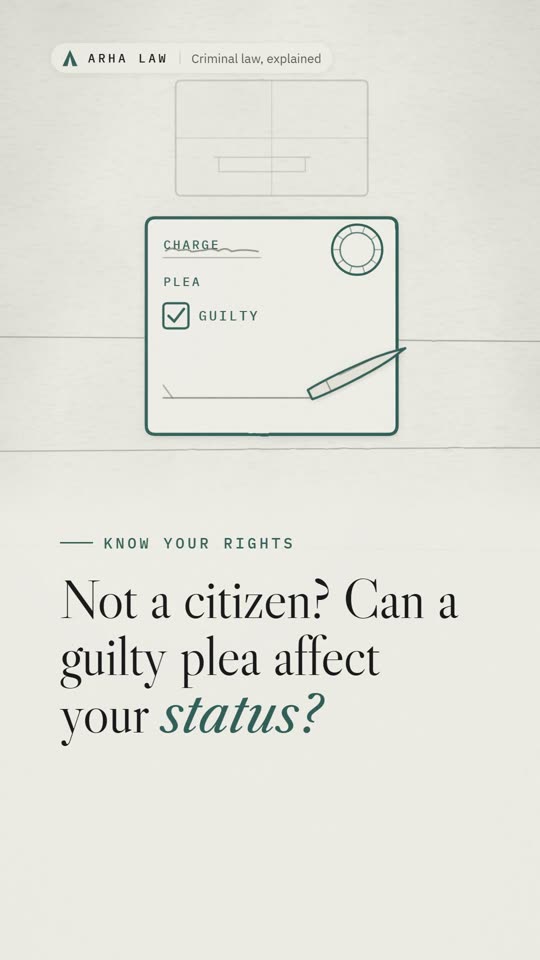
Not a citizen? Can a guilty plea affect your status?
Length 0:31
Not a citizen? Can a guilty plea affect your status?
Know your rights: Not a citizen? Can a guilty plea affect your status?
Yes. Ask first. It can cost you your status.
What counts: It's the conviction, and the sentence, not just the charge.
Even a short sentence: Even a short jail sentence can matter for your status. Six months or more can cost a permanent resident the right to appeal.
Ask first: A guilty plea works only if you understand what it means. Ask an immigration lawyer before you plead, not after.
What to do: Tell your lawyer you're not a citizen. Ask before you plead.
Where to go from here
- Review full disclosure with your lawyer before discussing a plea.
- Ask what a realistic sentencing range looks like for your specific facts, not just the maximum penalty.
- If you're not a Canadian citizen, ask specifically about immigration consequences before deciding anything.
- Take time. A plea entered in a rush is harder to walk back than one made after proper advice.
People also ask
Can I change my mind after pleading guilty?
Sometimes, but it requires a formal application to withdraw the plea and courts don't grant it easily. It's much better to decide carefully the first time.
Does pleading guilty mean a lighter sentence?
It can be a factor a judge considers, but it isn't a guarantee, and a joint submission still needs judicial approval.
Do I have to testify if I go to trial?
No. You have the right to remain silent, and the Crown must prove its case without any help from you.
Sources
- Criminal Code, s. 606, Justice Laws
- R. v. Anthony-Cook, 2016 SCC 43, Supreme Court of Canada
- R. v. Wong, 2018 SCC 25, Supreme Court of Canada
- Department of Justice Canada, Charterpedia, s. 11(d) Presumption of innocence
- Department of Justice Canada, Charterpedia, s. 11(c) Protection against testimonial compulsion
- Immigration and Refugee Protection Act, s. 36, Justice Laws
- Criminal Code, s. 536, Justice Laws
- Public Prosecution Service of Canada, Elections and Re-Elections
- Ontario Court of Justice, Step by Step
- Department of Justice Canada, Charterpedia, s. 11(f) Trial by jury
- Immigration and Refugee Protection Act, s. 36, Justice Laws
- Immigration and Refugee Protection Act, s. 64, Justice Laws
- Criminal Code, s. 730, Justice Laws
- Criminal Code, s. 811, Justice Laws
This page is general information about Ontario law as of September 2026. It isn't legal advice about your situation.