Impaired driving, over 80, and dangerous driving charges in Ontario
An impaired driving investigation can lead to two separate tracks: Ontario administrative penalties at the roadside, like a licence suspension and in some cases a vehicle impound, which apply without any conviction; and a criminal charge, which carries mandatory minimum fines or jail only if you're convicted. Since 2018, police with a screening device can demand a breath sample from any lawfully stopped driver, with no suspicion needed.
Dealing with this now? Call (416) 305-6019 or request a consultation
On this page
What counts as an impaired driving offence?
A few distinct charges sit under this heading: impaired operation, where alcohol or drugs affected your driving to any degree; over 80, where your blood alcohol was at or above 80 mg per 100 mL within two hours of driving; refusing a breath or drug demand; and dangerous driving, judged by how a reasonable driver would have acted, separate from any substance. For over 80, the Crown relies mainly on breath or blood results. For impaired operation, the Crown has to prove your ability to drive was impaired, even slightly. Since December 2018, an officer can demand a roadside breath sample from any lawfully stopped driver with no suspicion needed, and refusing without a reasonable excuse is its own criminal offence, with a minimum fine of $2,000.
Read what the video says
A RIDE stop. Now it's a criminal charge.
People call it a DUI. The law calls it impaired driving.
At the stop: At any lawful stop, police can demand a breath sample. No suspicion needed. Refusing a lawful demand, without a reasonable excuse, is its own crime.
Two tracks: One stop starts two tracks: your licence, and a criminal charge. Ontario acts on your licence now. The court decides the charge later.
Your licence: Blow 0.08 or more and Ontario suspends your licence for 90 days, on the spot. Plus a 7-day impound and $550 penalty (as of 2026). A court win won't undo it.
If convicted: A first conviction means at least a $1,000 fine and a one-year driving ban. Higher readings raise the minimum to $1,500 or $2,000 (as of 2026).
A record: The minimum penalty rules out a discharge. A conviction means a criminal record. Not a Canadian citizen? It can affect your status. Speak to an immigration lawyer too.
New in 2026: For offences on or after July 1, 2026, an ignition interlock is mandatory after conviction. A breath tester wired into your car. You pay for it.
One stop. Two roads. You don't have to face them alone.
What to do now
- Don't talk about the case, except with your lawyer.
- Keep every paper police gave you.
- Write down the time, the place and any tests.
- Call a lawyer early. Some options have a 90-day window.
What happens roadside, before any charge?
These are Ontario administrative penalties, separate from the criminal court process, and they apply without any conviction (as of 2026). In the warn range (BAC 0.05 to 0.079), a first occurrence brings a 7-day licence suspension and a $250 penalty, a second a 14-day suspension and $350, and a third a 30-day suspension, $450 and a 6-month ignition interlock condition, with education or treatment programs required. Where police find a reading of 0.08 or above, a refusal, or drug impairment, the usual consequences are an immediate 90-day suspension, a 7-day vehicle impound, and a $550 penalty. What applies in a given stop depends on the circumstances. Roadside penalties aren't a criminal record, but police can also lay a criminal charge on the same facts.
What are the criminal penalties if convicted?
As of 2026, the mandatory minimum fine for a first offence is $1,000, rising to $1,500 or $2,000 at higher BAC levels. A second offence carries at least 30 days in jail, a third or later at least 120 days, and a first conviction also brings a driving prohibition of at least one year. Causing bodily harm carries a maximum of 14 years. Causing death carries a maximum of life. Ontario adds its own consequences on conviction: a licence suspension of at least 1 year for a first conviction, 3 years for a second and a lifetime suspension for a third within 10 years, mandatory education or treatment, and an ignition interlock condition, a breath tester wired into your car at your own cost, for at least 9 months to a year after a first conviction, depending on the case. For offences on or after July 1, 2026, a minimum 6-month zero alcohol and drug condition follows the interlock period. Impaired driving causing death brings a lifetime licence suspension. Some first offenders can shorten their suspension through Ontario's reduced suspension program by installing an interlock early.
Watch more on this topic
-
 Length 0:34
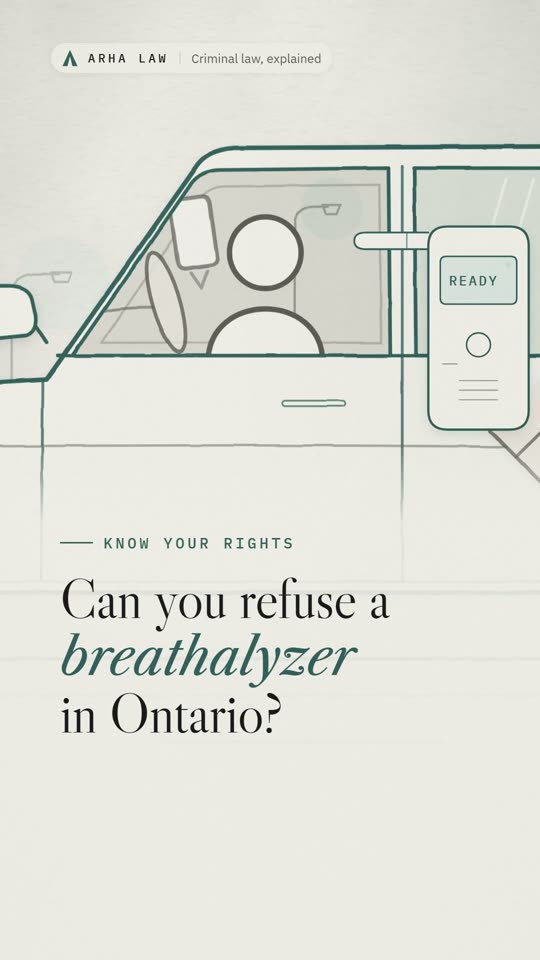
Can you refuse a breathalyzer?
Length 0:34
Can you refuse a breathalyzer?
Know your rights: Can you refuse a breathalyzer in Ontario?
Not without a reason. Refusing a lawful demand without a reasonable excuse is its own crime.
The fine: The minimum fine for a first refusal is $2,000. That's double the basic impaired minimum. A conviction also brings at least a one-year driving ban.
In Ontario: Your licence is suspended for 90 days, and the car is impounded for 7 days. Plus a $550 penalty. It starts right away. No conviction needed.
The roadside test: You don't get to call a lawyer before the roadside test. The Supreme Court allows this because the test has to happen right away.
What to do: At the station, ask to talk to a lawyer before the breath tests. Free advice by phone, 24/7: ask for duty counsel.
-
 Length 0:30
Myth: "First offence, nothing happens"
Length 0:30
Myth: "First offence, nothing happens"
Myth or fact: “First offence, nothing happens.”
Myth. A first offence matters. It doesn't erase the charge.
Same process: A first charge goes through the same process as any other. Diversion isn't automatic for first offenders.
For example: First impaired driving conviction: at least a $1,000 fine and at least a one-year driving ban. No discharge is possible. A conviction means a criminal record.
Where it helps: Having no record can count in your favour at sentencing. A pre-sentence report lists any past findings of guilt or diversion.
What to do: Treat a first charge seriously. Get advice before your first court date.
-
 Length 1:02
50 over isn't a speeding ticket. It's stunt driving.
Length 1:02
50 over isn't a speeding ticket. It's stunt driving.
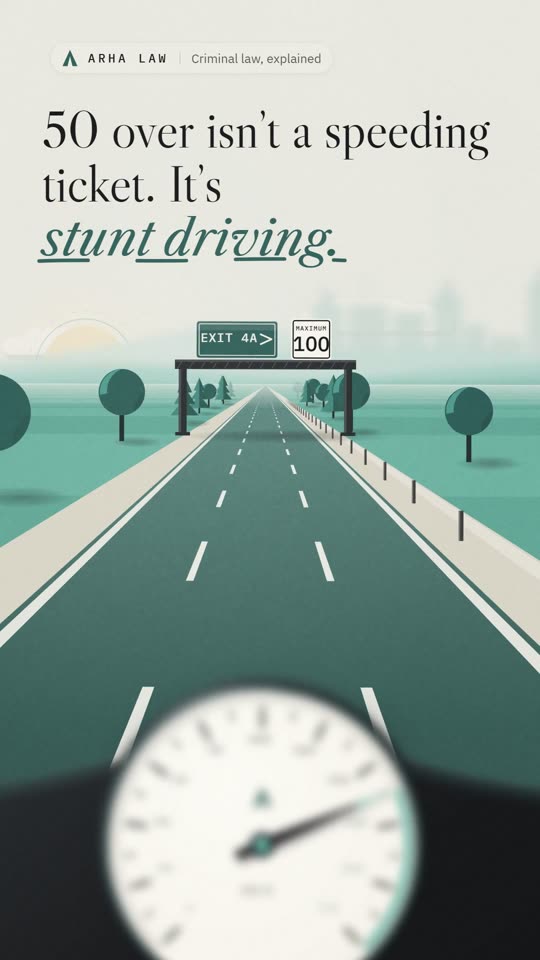
50 over isn’t a speeding ticket. It’s stunt driving.
The numbers: In a zone under 80, 40 over counts. And 150 km/h counts anywhere in Ontario.
Not only speed: Racing, cutting someone off, or tailgating as close as you can can count too.
At the roadside: Police take your licence on the spot: 30 days suspended. Before any court date. No hearing first.
Your car: The car is impounded for 14 days. The owner pays the tow and storage. Even if it’s your parent’s car.
Then court: The roadside penalties are separate from the court case. If convicted: a $2,000 to $10,000 fine. Up to six months’ jail.
And more: A conviction also means at least a one-year licence suspension. Plus 6 demerit points.
Not criminal, still serious: It’s a provincial offence, not a Criminal Code charge. It goes on your driver record, and insurance can rise a lot.
The 30 days start tonight. The court case comes after.
What to do now
- Don’t drive while suspended. That’s its own offence.
- Keep every paper police gave you.
- Note your court date.
- Get legal advice before your first court date.
-
 Length 1:02
One bad lane change. Two very different charges.
Length 1:02
One bad lane change. Two very different charges.
One bad lane change. Two very different charges.
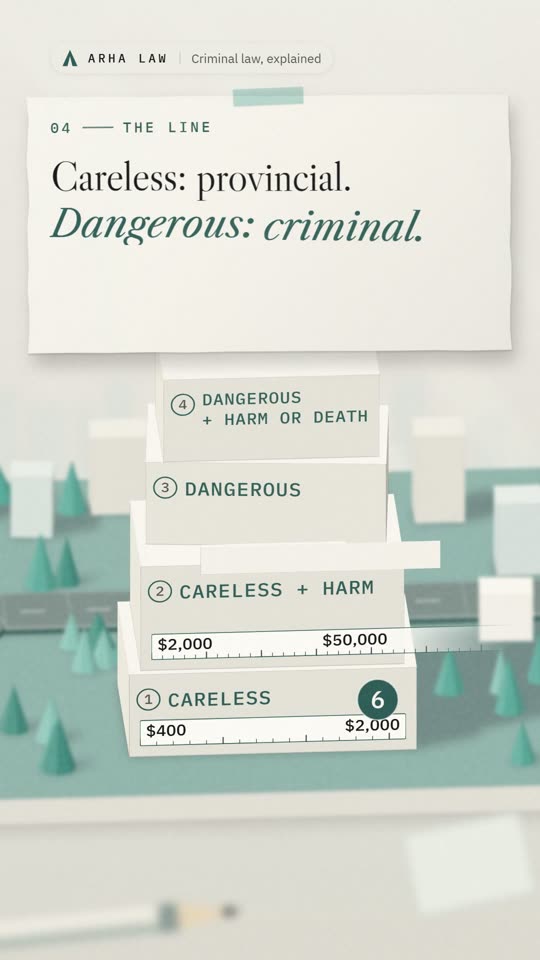
The ladder: Four charges, one ladder.
Careless: Careless driving is a Highway Traffic Act charge. Provincial, not criminal. On conviction: $400 to $2,000, or up to six months’ jail. Plus 6 demerit points.
Careless, someone hurt: If careless driving hurts someone, the charge is more serious. On conviction: $2,000 to $50,000, or up to two years.
The line: Careless: provincial. Dangerous: criminal. A Highway Traffic Act charge, or a Criminal Code charge.
Dangerous: Dangerous driving is a Criminal Code offence. Up to 10 years. No minimum for this one.
Immigration: A criminal conviction can affect your immigration status. Not a citizen? Speak to an immigration lawyer too.
Someone hurt, someone killed: If someone is hurt: up to 14 years. If someone dies: up to life. Both carry a minimum. First offence: a $1,000 fine.
On your record: Careless goes on your driver record. A dangerous driving conviction is a criminal record.
Provincial or Criminal Code? Know which is on your paper.
What to do now
- Find out which Act you’re charged under.
- Keep every paper police gave you.
- Note your court date.
- Get legal advice before your first court date.
-
 Length 0:29
Stunt driving: your licence and your car, before court
Length 0:29
Stunt driving: your licence and your car, before court
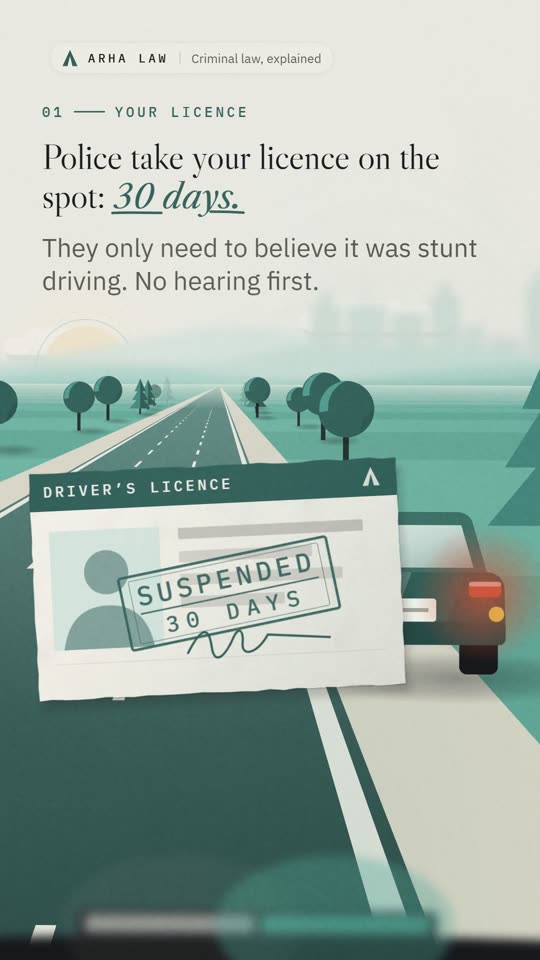
Stunt driving: They take your licence and your car before you see a judge.
Your licence: Police take your licence on the spot: 30 days. They only need to believe it was stunt driving. No hearing first.
Your car: The car is impounded for 14 days. The owner pays. Even if it’s your parent’s car.
Then court: The roadside penalties are separate from the court case. If convicted: $2,000 to $10,000. Up to six months’ jail.
What to do now
- Don’t drive while suspended. That’s its own offence.
- Keep every paper police gave you.
- Get legal advice before your first court date.
-
 Length 0:35
Careless or dangerous? Only one is a criminal charge
Length 0:35
Careless or dangerous? Only one is a criminal charge
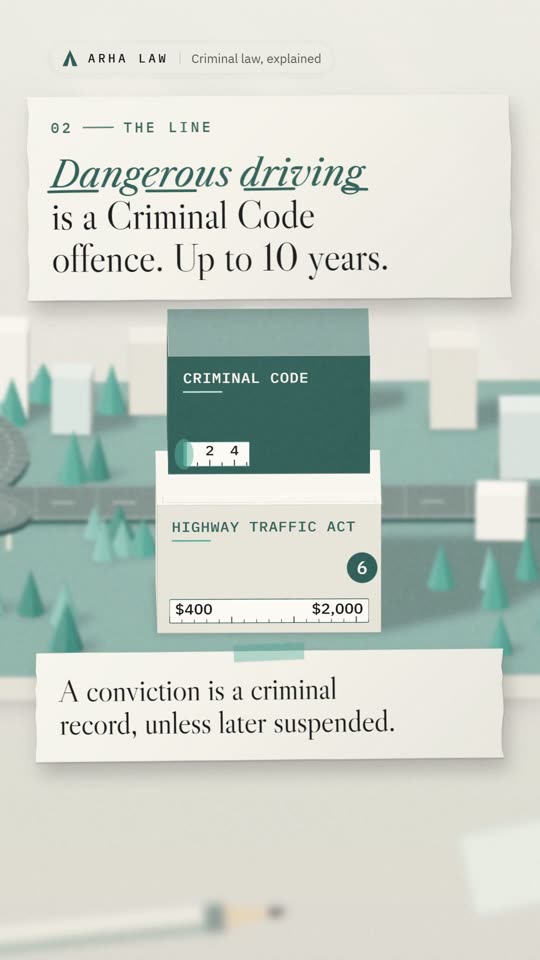
Careless or dangerous?: Only one is a criminal charge.
Careless: Careless: a Highway Traffic Act charge. $400 to $2,000 on conviction. Up to six months’ jail. 6 demerit points.
The line: Dangerous driving is a Criminal Code offence. Up to 10 years. A conviction is a criminal record, unless later suspended.
Someone hurt: Someone hurt? Both charges get more serious. Careless: up to $50,000. Dangerous: up to 14 years.
What to do now
- Find out which Act you’re charged under.
- Note your court date.
- Get legal advice before your first court date.
-
 Length 0:30
Myth: "I only had two drinks, so I'm under the limit"
Length 0:30
Myth: "I only had two drinks, so I'm under the limit"
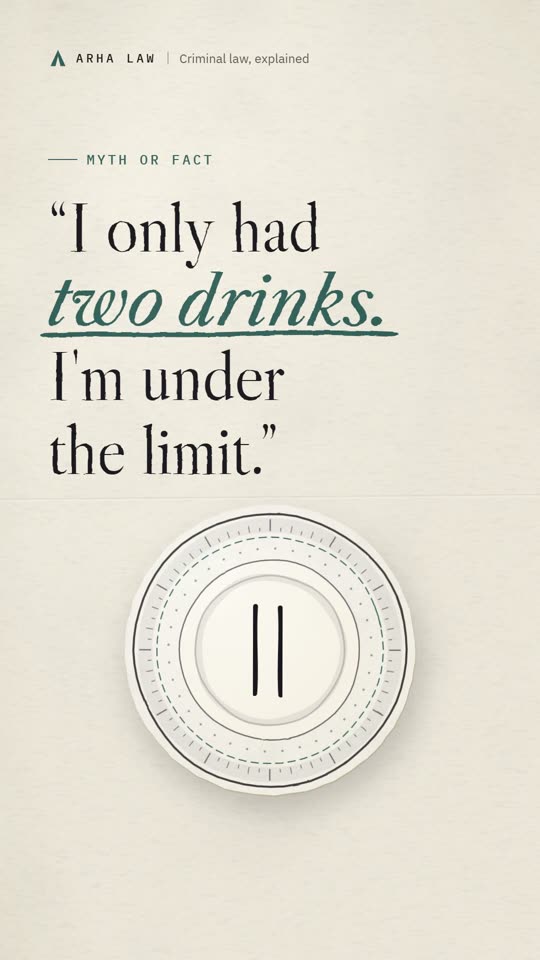
Myth or fact: “I only had two drinks. I'm under the limit.”
The law doesn't count drinks.
Any degree: Impaired to any degree is a crime, whatever your reading.
The limits: Driving at 0.08 or more is a crime. 0.05 starts Ontario's roadside penalties.
No safe count: The law sets no safe number of drinks. First time in the warn range: 7 days without your licence.
Myth.
What to do: Charged? Get advice early.
-
 Length 0:35
Half true: "Driving while suspended is just a fine"
Length 0:35
Half true: "Driving while suspended is just a fine"
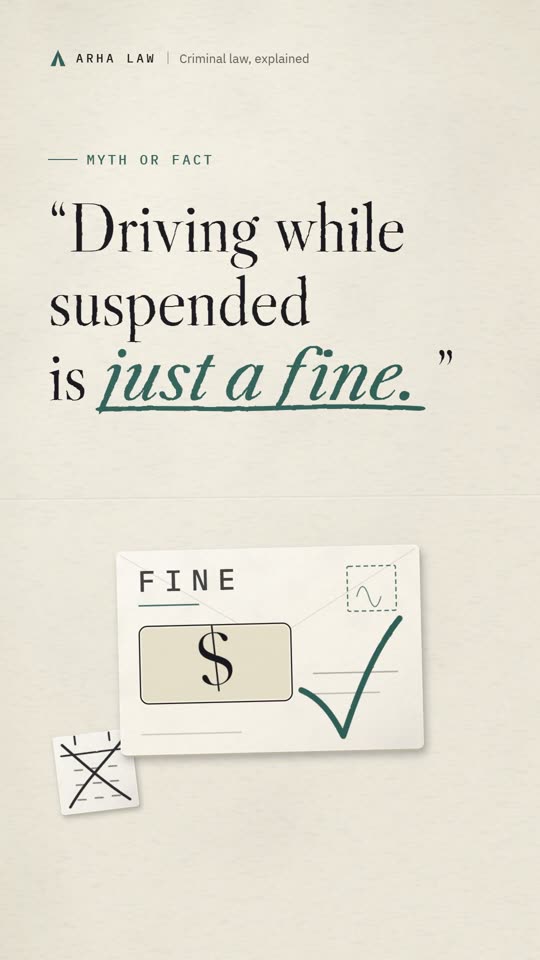
Myth or fact: “Driving while suspended is just a fine.”
The law says it's more than a fine.
The fine: For most suspensions, it's a provincial offence. First offence: a $1,000 to $5,000 fine.
More than a fine: Up to six months' jail is possible. A conviction adds six more months to the suspension.
Car and court order: The car can be impounded. The owner pays. Driving against a Criminal Code ban is a criminal offence.
Half true.
What to do
- Check your licence status. It's free online.
- Charged? Get advice early.
-
 Length 0:39
Myth: "It's not my car, so they can't impound it"
Length 0:39
Myth: "It's not my car, so they can't impound it"
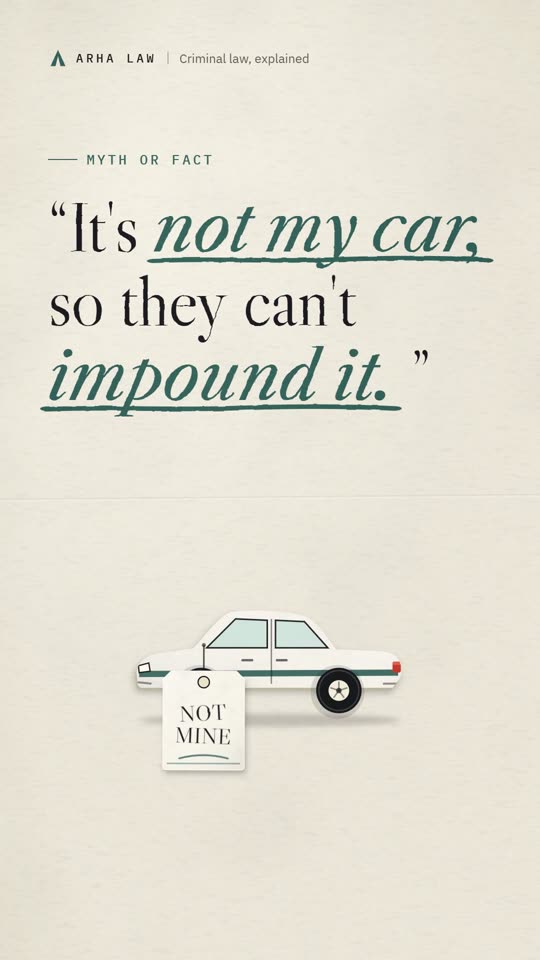
Myth or fact: “It's not my car, so they can't impound it.”
The impound isn't about whose car it is.
The car you're driving: Stunt driving: the car you're driving is impounded for 14 days. 0.08 or more, or a refusal: 7 days.
Who pays: The owner pays the tow and storage. Whoever was driving.
The driver: The owner can sue the driver to try to recover it. A lawsuit, not a guarantee.
Myth.
What to do
- Lending your car? Check the driver's licence status first.
- Charged? Get advice early.
-
 Length 0:40
Half true: "I was parked, so it can't be impaired driving"
Length 0:40
Half true: "I was parked, so it can't be impaired driving"
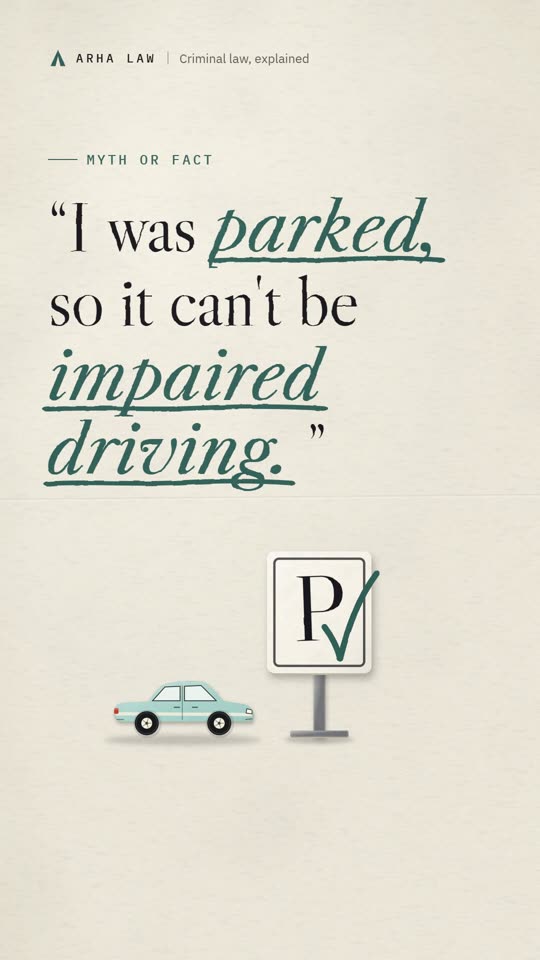
Myth or fact: “I was parked, so it can't be impaired driving.”
The law's word is operate.
The word: The Criminal Code says operate, not just drive. Being parked doesn't automatically clear you.
Care or control: Operating includes care or control. You can be charged in a parked car.
It depends: Whether someone had care or control depends on the facts. A conviction means a criminal record.
Half true.
What to do: Charged while parked? Get advice early.
Where to go from here
- Don't discuss the incident with police beyond your licence and basic information. Staying silent isn't refusing a test: refusing a lawful demand is a crime.
- Note the time of the stop, any tests given, and the officer's badge number if you can.
- Some options, like Ontario's reduced suspension program, only work if your case ends within 90 days.
People also ask
Can I refuse a roadside breath test?
Refusing without a reasonable excuse is its own criminal offence. The minimum fine is higher than for most first impaired convictions.
Will I lose my licence right away?
If police impose a roadside penalty for the warn range, over 80, a refusal or drug impairment, yes. That suspension starts immediately and is separate from what happens later in court.
Does a conviction affect immigration status?
Yes. Since December 2018, impaired driving carries a 10-year maximum sentence, which makes a conviction serious criminality for immigration. Get immigration advice before you plead.
Sources
- https://laws-lois.justice.gc.ca/eng/acts/c-46/section-320.14.html
- https://laws-lois.justice.gc.ca/eng/acts/c-46/section-320.19.html
- https://www.justice.gc.ca/eng/cj-jp/sidl-rlcfa/qa-qr.html
- https://www.ontario.ca/page/impaired-driving
- https://www.ontario.ca/page/vehicle-impoundment-suspended-drivers-licence
- https://www.ontario.ca/page/ignition-interlock-program
- https://laws-lois.justice.gc.ca/eng/acts/c-46/section-320.15.html
- https://laws-lois.justice.gc.ca/eng/acts/c-46/section-320.2.html
- https://laws-lois.justice.gc.ca/eng/acts/c-46/section-320.21.html
- https://www.ontario.ca/page/reduced-suspension-ignition-interlock-conduct-review-program
- https://laws-lois.justice.gc.ca/eng/acts/i-2.5/section-36.html
This page is general information about Ontario law as of September 2026. It isn't legal advice about your situation.