Uttering Threats and Criminal Harassment Charges in Ontario
Uttering threats covers a single threat of death, harm, or property damage, even by text or online. Criminal harassment covers a pattern of following, watching, monitoring, or repeated contact that makes someone reasonably fear for their safety. Both are taken seriously even when nothing physical happened.
Dealing with this now? Call (416) 305-6019 or request a consultation
On this page
What counts as uttering a threat?
You commit this offence by knowingly threatening to kill or hurt someone, to damage or destroy property, or to kill or injure someone's animal. It doesn't matter if you never meant to follow through. What matters is whether a reasonable person would have taken the words as a real threat, and whether you meant them to intimidate or be taken seriously, not an obvious joke or a heated exchange anyone would recognize as venting. A single text, DM, or comment can be enough. For a threat of death or bodily harm, the maximum is 5 years if the Crown proceeds by indictment (the more serious process). For a threat to property or an animal, it's 2 years by indictment. Either kind can instead go summarily, with a maximum of 2 years less a day. There's no mandatory minimum.
Read what the video says
It was just a text. That can be a crime.
Threats: Threatening death or bodily harm, even by text, can be a crime. One message can be enough.
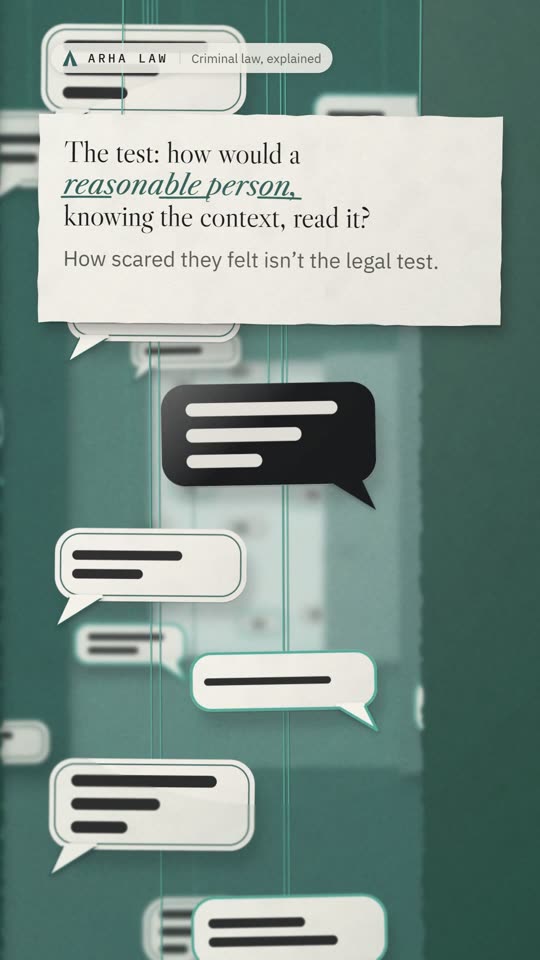
The test: The test: how would a reasonable person, knowing the context, read it? How scared they felt isn’t the legal test.
What the Crown must prove: The Crown must also prove you meant to intimidate or be taken seriously. It doesn’t have to be carried out.
Harassment: Criminal harassment is its own offence. It often involves repeated contact. It can include following, repeated messages, or monitoring someone.
The harassment test, as of 2026: Could the conduct reasonably make someone believe their safety is threatened? Safety includes psychological safety. It also takes intent to harass, or recklessness.
The ceiling: Threats of death or harm: up to 5 years. Harassment: up to 10. A maximum is a ceiling, not a prediction.
The law reads the words and the context.
What to do now
- Charged? Talk to a lawyer before you do anything with the messages.
- Note your court date and keep every paper.
- Bail can bar all contact. See our no-contact video.
What counts as criminal harassment?
Criminal harassment is repeated conduct such as following someone, repeatedly contacting them, watching their home or workplace, monitoring their location or online activity, or threatening them or someone close to them, done in a way that makes the person reasonably fear for their safety or the safety of someone they know. A single incident usually isn't enough. This is a hybrid offence: up to 10 years by indictment, or up to 2 years less a day summarily.
What about harassing calls, texts, or messages?
There's a separate, lower-level offence for repeated harassing communications by phone or any telecommunication, without lawful excuse and with intent to harass. It also covers indecent messages and knowingly false information sent to alarm someone. The maximum is 2 years by indictment, or a lesser summary penalty.
What are the common defences?
- The words weren't meant to be taken seriously, and a reasonable person wouldn't have taken them that way, for uttering threats.
- The conduct wasn't repeated, or didn't actually cause the other person to fear for their safety, for criminal harassment.
- Someone else sent the message or made the call, which can turn on phone or account records.
- Context matters: the full conversation, not one line pulled out, usually decides these cases.
What typically happens after a charge, and does it affect immigration status?
A first-time allegation with no history of contact or violence sometimes resolves through a peace bond, a court order to keep the peace for a set period, without a guilty plea or conviction. See our page on peace bonds and diversion. More serious or repeated conduct can lead to probation or jail. Bail conditions commonly include no contact with the person, directly or through anyone else. A conviction can also affect immigration status for non-citizens, so speak to an immigration lawyer too.
Watch more on this topic
-
 Length 0:31
A threatening text: what the Crown must prove
Length 0:31
A threatening text: what the Crown must prove
It was just a text. That can be a crime.
Threatening death or bodily harm, even by text, can be a crime. One message can be enough.
The test: how would a reasonable person, knowing the context, read it? How scared they felt isn’t the legal test.
The Crown must also prove you meant to intimidate or be taken seriously.
Threat of death or bodily harm: up to 5 years. A ceiling, not a prediction.
What to do
- Charged? Talk to a lawyer before you do anything with the messages.
Where to go from here
- Save everything: texts, call logs, emails, and social media messages, both sent and received.
- Don't contact the other person again to explain yourself. It can look like more of the same conduct.
- Write down the context around any message the Crown is relying on.
People also ask
Can I be charged for something I said and didn't mean?
Possibly. The Crown has to prove a reasonable person would take the words as a threat, and that you meant them to intimidate or be taken seriously.
Does criminal harassment require actual contact?
No. Watching someone's home, or repeatedly showing up where they'll see you, can count even without direct contact.
Can a peace bond resolve a criminal harassment charge?
Sometimes, for a first-time, lower-risk situation, but it needs the Crown's agreement and usually no history of similar conduct.
Is one angry text enough for criminal harassment?
Usually not on its own. Criminal harassment generally needs a pattern, though a single threat can still be its own separate charge.
Sources
This page is general information about Ontario law as of September 2026. It isn't legal advice about your situation.