Can I change my bail conditions, and what happens if I breach them?
Bail conditions can be changed if both sides agree or through a court application. Breaking a condition, even a minor one, is a separate criminal charge and can hurt your chances of getting bail again.
Dealing with this now? Call (416) 305-6019 or request a consultation
On this page
What kinds of conditions come with release?
Conditions address the specific risk in your case, not to punish you before trial. Common ones include no contact with a named person, staying away from an address, a curfew or house arrest with an approved supervisor, reporting to police on a schedule, and not possessing weapons.
For auto theft and home break-in charges, courts must now also consider geographic limits, curfews, and bans on possessing break-in tools, under bail reforms in force since July 15, 2026.
Read what the video says
Bail says no contact. But you're raising kids together.
Don't break it. Change it. Only the court can change it, not the complainant.
By agreement: It can change if you, the Crown and every surety agree in writing. In Ontario the form goes to the Crown, then to a judicial official.
Bring a reason: The Crown looks at whether something has changed, like a new care plan for your kids. The court still has to approve the change.
If the Crown says no: You can ask a Superior Court judge to review your bail. You have to show why it should change.
What the judge looks at: A judge can change it for an important new fact, or if the first decision was wrong. It isn't a fresh start. R v St-Cloud, Supreme Court of Canada, 2015.
Breaking it instead: Even one text can be a new charge, with up to two years in jail. Your bail can be cancelled. Then it's on you to show a clear plan.
Change it before, not after.
While you wait: In a family court case, its order doesn't replace your bail. You need both.
- No contact while you wait.
- No messages through the kids.
- Have your lawyer ask the Crown.
Can I get my conditions changed?
Yes, in two ways. If the Crown agrees, conditions can usually be changed by consent without a contested hearing, with the written consent of any surety where required. If the Crown doesn't agree, you can ask a Superior Court judge to review your bail. You have to show why it should change, and the judge can only change it in limited situations, such as new evidence that your circumstances have really changed. (If police released you on an undertaking, the application goes to a justice in the Ontario Court of Justice instead.) A lawyer can help, for example if you need contact with a co-parent, or need to work in an area you're barred from.
What counts as a breach, and does it always get charged?
Breaking any condition counts as a breach, even something that seems minor, like missing a curfew by an hour or texting someone you're not supposed to contact. Missing a court date is treated separately, but just as seriously. Whether a breach is charged is up to police and the Crown. In some cases the Crown can send it to a judicial referral hearing instead of laying a new charge, but that's the Crown's choice, not yours. Don't assume a small condition doesn't matter.
What happens if I breach a condition?
Breaching your release is its own criminal offence. You can be arrested again, and bail is harder to get the second time: a new breach raises the risk you'll be held, and if you're charged with breaching a release while already out on another charge, the burden generally shifts to you to show, with a clear release plan, why you should be released again. A breach doesn't make your original charge stronger, but it complicates your case.
Watch more on this topic
-
 Length 1:01
Breaking a bail condition
Length 1:01
Breaking a bail condition
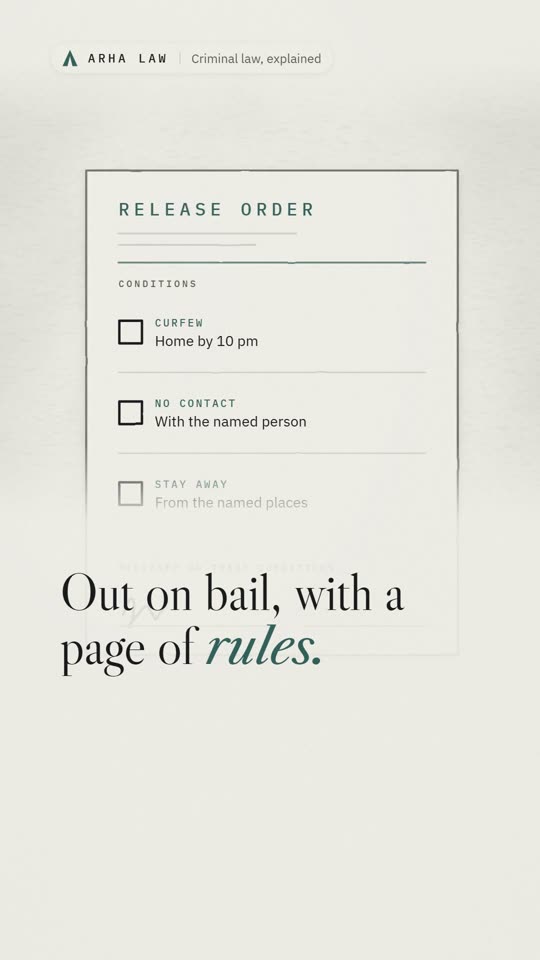
Out on bail, with a page of rules.
One slip can put you back inside.
What counts: Break any condition and it's a breach, even if what you did is legal. Forgetting or misunderstanding a condition usually isn't enough on its own.
A new charge: A breach is a new charge, on top of the one you already face. No harm, damage or loss? The Crown may choose a bail hearing over a new charge.
Your release: Arrested for a breach? A judge can cancel your bail.
The burden flips: Charged with a breach? At the next bail hearing, you usually must show why you should be released. If your bail was cancelled, your plan must clearly show it deals with the risks.
Changing a condition: You, the Crown and every surety can agree to a change in writing. No agreement? You can ask a judge to review your bail.
Change it before you break it. Not after.
What to do
- Read every condition. Ask about anything unclear.
- Set reminders for curfew and reporting times.
- Need a change? Ask a lawyer before you act.
- Slipped up? Get legal advice the same day.
-
 Length 1:02
Asked to be a surety? Read this first
Length 1:02
Asked to be a surety? Read this first
You've been asked to be a surety.
It's more than a signature.
The promise: You promise the court you'll supervise them, so they follow every condition and come to court. It lasts until the case is over. That can take months.
The money: The court may ask you to pledge money. You can lose it if they break the conditions. A judge decides if you pay all, part or none of it.
No payment: You can't be paid for this. Taking a fee, or being paid back, is a crime. That includes being paid back by the person you sign for.
Who can be one: A judge checks your money, your record and whether you can really supervise. An indictable conviction in the last 10 years usually rules you out.
Stepping away: You can ask the court, in writing, to be removed as surety. Feel unsafe? Don't bring them in yourself. Once you're removed, police make the arrest.
You're signing for their choices.
Before you sign, ask a lawyer
- What conditions will I be supervising?
- How much am I pledging, and how could I lose it?
- How long could this last?
- How do I step away if I need to?
-
 Length 1:00
Does a like count as contact?
Length 1:00
Does a like count as contact?
You liked their post.
That can be a breach. No contact means no contact.
It still counts: “Reply.” A like, a reaction, or a reply to their story can be contact. So can a follow, or a “happy birthday” from a new account.
Through someone else: A message passed through a friend, your mom, or your child still counts. If you're asked to pass it on, say no. It can make you part of the breach.
If they contact you: If they call, text, or message you, don't reply. Screenshot it. Then tell your lawyer, not them.
If you break it: Any of this can be a new charge, with up to two years in jail. Your bail can be revoked. Then you must show why you should be released.
Changing it: They can't change it. Only the court, or a written consent with the Crown, can. Go through your lawyer. Contact about your kids can sometimes be added.
However it reaches them, it still counts.
What to do
- Don't like, react, or reply, even from a new account.
- No messages through friends, family, or your kids.
- Contacted first? Don't reply. Screenshot it.
- Want a change? Ask your lawyer, not them.
-
 Length 0:34
A bail condition you can't live with? Can it change?
Length 0:34
A bail condition you can't live with? Can it change?
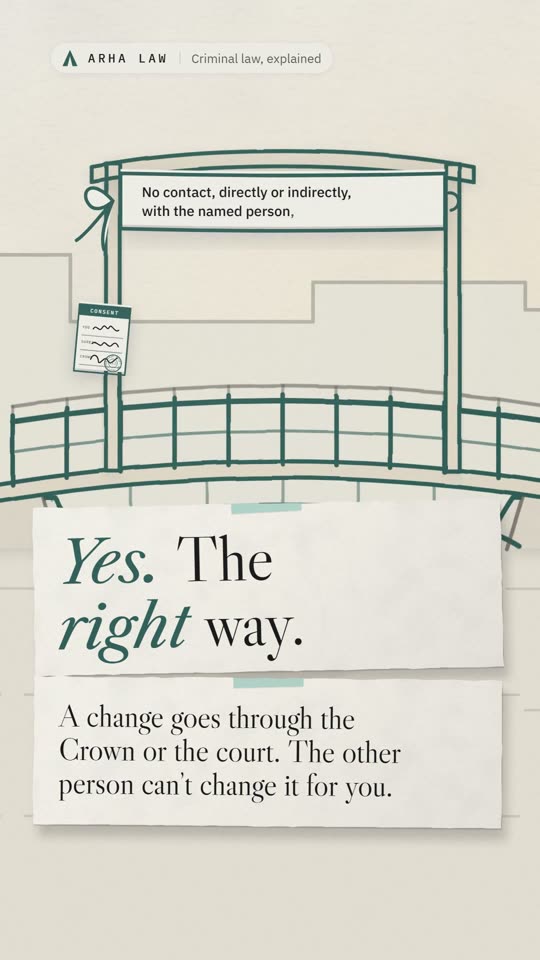
A change goes through the Crown or the court. The other person can’t change it for you.
By agreement: Then a judicial official reviews it.
Breaking it: Even one text can be a new charge.
What to do now
- Change it before you break it.
- Follow it until it’s changed.
Where to go from here
- Read your release conditions carefully and ask a lawyer about anything unclear before you leave.
- If a condition is unworkable, ask about changing it before you break it, not after.
- If you've been charged with a breach, don't wait: the case moves quickly and affects your bail.
People also ask
Can my surety get in trouble if I breach?
Yes. A surety who fails to properly supervise you can be ordered to forfeit some or all of the pledged amount, and can ask to be removed if they no longer feel able to supervise.
Is a breach charge the same as violating parole?
No. Parole applies after a sentence. A breach happens while your case is still before the court, before conviction.
Can I travel while on bail?
Only if your conditions allow it. Many release orders include a geographic restriction, so check before making plans.
What if the other person contacts me first?
Tell your lawyer right away and keep evidence of the contact. Responding, even briefly, can still count as a breach.
Sources
- Criminal Code, s. 145, Justice Laws
- Criminal Code, s. 515, Justice Laws
- Criminal Code, s. 520 (bail review), Justice Laws
- Criminal Code, s. 523.1 (judicial referral hearing), Justice Laws
- Criminal Code, s. 524, Justice Laws
- R. v. St-Cloud, 2015 SCC 27, Supreme Court of Canada
- Ontario Court of Justice, Consent Variation Procedures for Release Orders and Police Undertakings
- Department of Justice Canada, Bail and Sentencing Reform Act (Bill C-14)
This page is general information about Ontario law as of September 2026. It isn't legal advice about your situation.