What is disclosure and what happens at a Crown pre-trial?
Disclosure is the evidence the Crown (the prosecutor) has to give your lawyer: officer notes, statements, video, everything relevant to your charge. A Crown pre-trial is a meeting where your lawyer and the Crown discuss the case and possible resolutions. Don't decide anything about your case until your lawyer has seen the disclosure.
Dealing with this now? Call (416) 305-6019 or request a consultation
On this page
What exactly is disclosure?
Disclosure is the material police and the Crown have gathered about your charge: officer notes, witness statements, video or photos, forensic reports, and your criminal record if you have one. Under a 1991 Supreme Court of Canada ruling called Stinchcombe, the Crown has a constitutional duty to give the defence all relevant, non-privileged material, whether it helps or hurts its case.
Read what the video says
Charged. Then weeks of nothing.
That wait has a name: disclosure.
What it is: The Crown, the prosecutor, must share the relevant information with your side. What helps you, not only what hurts. R. v. Stinchcombe, Supreme Court of Canada, 1991.
Why it takes time: Police hand their file to the Crown. The Crown passes it to your lawyer. It often comes in stages. More arrives as the Crown gets it.
What's inside: It can include witness statements, officers' notes, video and photos. Usually a Charge Screening Form too. It may show the Crown's position on resolving the case.
Your lawyer's part: Your lawyer asks for it, reviews it, and flags anything missing. The Crown can hold back only narrow things, like privileged material. A judge can review that.
Before you decide: You should see it before you plead or choose your type of trial. Seeing the evidence early helps many cases end without a trial.
Quiet weeks are normal. The file comes in stages.
What you can do
- Let your lawyer request it early.
- Tell your lawyer anything you think is missing.
- Don't decide on a plea before it's been reviewed.
- Go to every court date unless your lawyer says otherwise.
How do I actually get it?
Your lawyer requests disclosure from the Crown's office handling your case, ideally before your first court date, so there's something to review when you appear. It typically arrives electronically: PDFs, video files, sometimes a disc. Initial disclosure covers the basics; forensic results, expert reports, or extra witness statements often follow later.
How long does it take?
There's no fixed deadline in the Criminal Code. A simple case can have disclosure ready by the first appearance. Cases with video, forensic testing, or many witnesses take longer, and it often arrives in stages. If disclosure is slow, that delay counts against the overall clock on your case, which is one reason your lawyer tracks it closely.
What is the Crown's initial position, and what is a Crown pre-trial?
Your disclosure usually includes a one-page Crown screening form (also called a charge screening form). It lists your charges and may include the Crown's position on resolving the case. That position can change as more information comes in. A Crown pre-trial is a meeting, usually a call or short conversation, between your lawyer and the Crown to go over the strength of the evidence and whether the matter can resolve without a trial, for example through a plea to a lesser charge or a withdrawal. Only you can decide to accept an offer.
What is a judicial pre-trial, and why does the Jordan clock matter?
A judicial pre-trial is a separate meeting, this one with a judge as well as your lawyer and the Crown, to narrow the issues before trial and confirm realistic time estimates. It isn't public and it doesn't decide your case. Separately, the Supreme Court's Jordan decision set outer time limits for a case, from charge to the end of trial, before it's presumed to violate your right to a trial within a reasonable time: 18 months for cases staying in the Ontario Court of Justice, and 30 months for cases in the Superior Court. Passing the ceiling doesn't automatically end a case; the Crown can point to exceptional circumstances, and delay caused by the defence doesn't count. The Ontario Court of Justice also sets its own targets: it offers trial dates aimed at finishing within 15 months of the charge being sworn, and within six months both sides are expected to resolve the case or set a trial date. If most of the disclosure hasn't arrived within four months, a judicial pre-trial must be booked. For charges sworn on or after June 1, 2026, an out-of-custody adult case should have no more than three case management appearances unless a judge orders otherwise. These are scheduling targets, not promises. See our sentencing page for what happens after a plea, and our plea page for how that decision gets made.
Watch more on this topic
-
 Length 1:05
Crown pre-trial and judicial pre-trial, explained
Length 1:05
Crown pre-trial and judicial pre-trial, explained
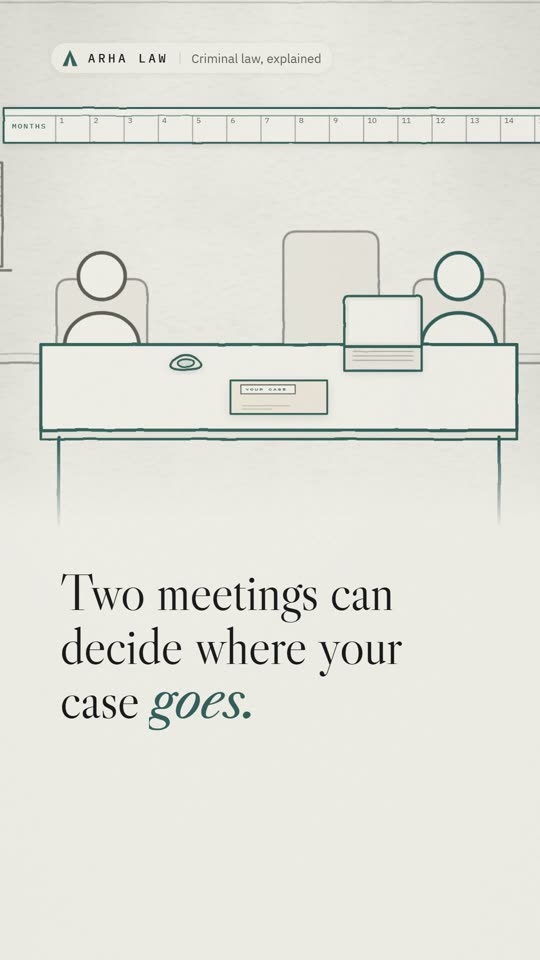
Two meetings can decide where your case goes.
Neither one is the trial.
The Crown pre-trial: Your lawyer and the Crown talk about your case, and whether it can be resolved. In person, by phone or even by email. It isn't a court hearing.
The judicial pre-trial: Then a meeting with a judge, the Crown and your lawyer. Still not the trial. It covers ways to resolve the case and how long a trial would take.
Two ways forward: After these steps, the case should be ready to resolve, or to set a trial date. Resolving can mean a withdrawal, diversion or a guilty plea.
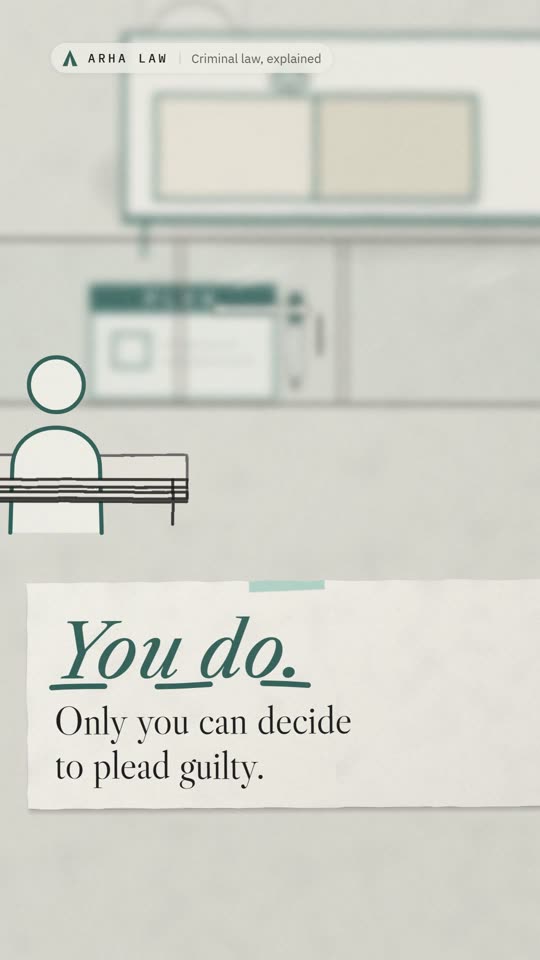
Your part: With a lawyer, you usually don't attend the judicial pre-trial yourself. Only you can decide whether to plead guilty.
The clock: Your case has a time limit: 18 months in the Ontario Court of Justice, 30 in Superior Court. Delay your side causes doesn't count.
Past the limit: Going past it can lead to a stay. For newer offences, a judge must look at other remedies first. Newer means offences on or after July 18, 2026.
Meetings, not a verdict.
Before the meetings
- Tell your lawyer everything before the Crown pre-trial.
- Ask what the Crown's position means for you.
- Decide on a plea only after you've seen the disclosure.
-
 Length 1:05
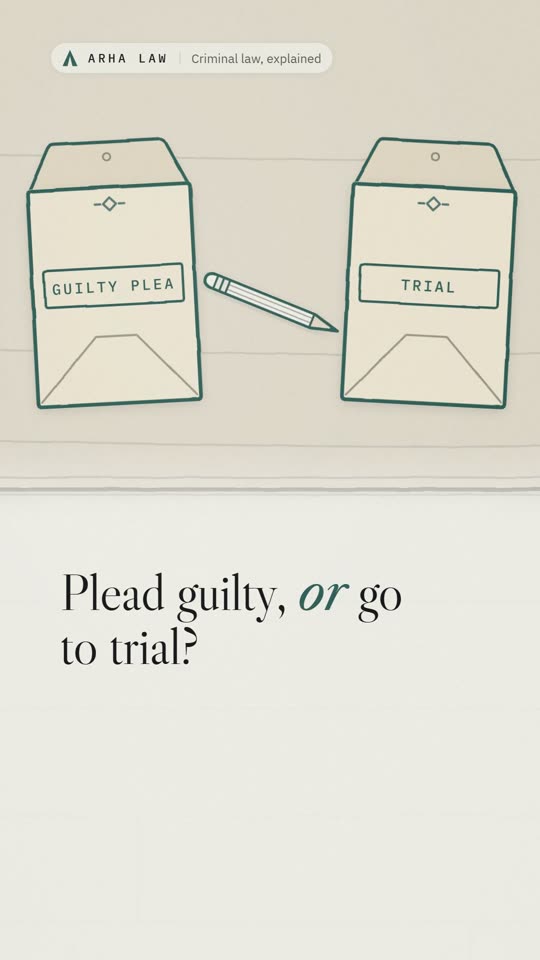
Plead guilty, or go to trial?
Length 1:05
Plead guilty, or go to trial?
Plead guilty, or go to trial?
It isn't a gut call.
First, the evidence: Start with the disclosure: the evidence the Crown has given your lawyer. It includes what helps you, not just what hurts.
Your lawyer's read: Go through all of it with your lawyer. The decision is still yours. What's strong, what's weak, and what's missing.
If you go to trial: You're presumed innocent. The Crown must prove the charge beyond a reasonable doubt. You don't have to prove anything, or testify.
If you plead guilty: A guilty plea admits every part of the charge. It must be voluntary and informed. The judge must be satisfied you understand what follows.
Resolution discussions: Your lawyer and the Crown may agree on a sentence to suggest. The judge isn't bound by it. Judges rarely reject a joint position. The bar is very high.
Immigration: If you're not a citizen, a guilty plea can cost you your status and lead to removal. Speak to an immigration lawyer before you plead, not after.
A plea is hard to take back. Decide with all of it.
Ask your lawyer
- What does the disclosure show, and what's missing?
- What would the Crown have to prove at trial?
- What follows from a guilty plea in my case?
- Could this affect my immigration status?
-
 Length 0:30
Myth: "The witness didn't show up, so my case is dismissed"
Length 0:30
Myth: "The witness didn't show up, so my case is dismissed"
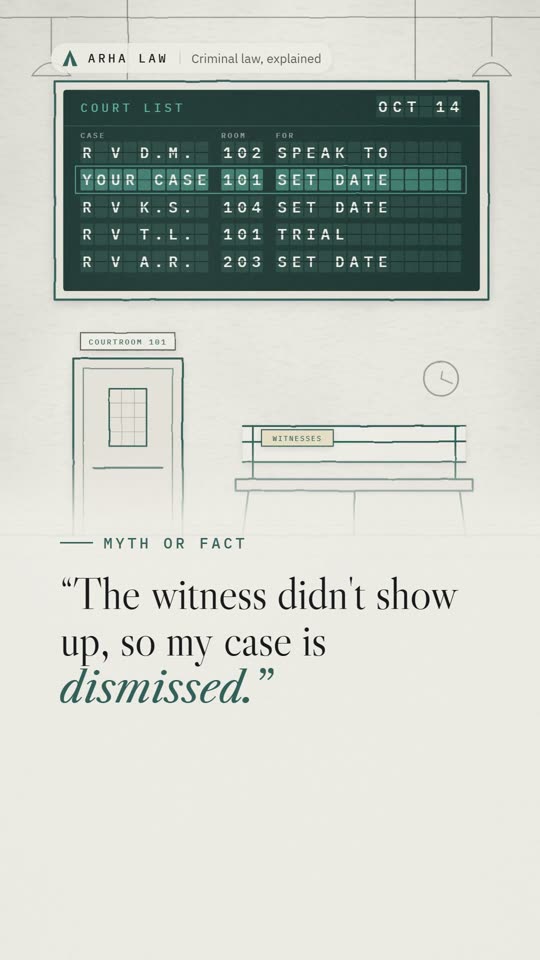
Myth or fact: “The witness didn't show up, so my case is dismissed.”
Myth. Early dates don't need the witnesses.
Early dates: Early court dates aren't trials. No one gives evidence there. So witnesses aren't expected there. They testify at trial.
At trial: Witnesses, police included, can be ordered to come by subpoena, and must stay until excused. A trial date is expected to go ahead unless a judge allows an adjournment.
If one is missing: The Crown can ask for more time. A judge decides.
What to do: Go to every court date unless your lawyer or the court says otherwise.
-
 Length 0:29
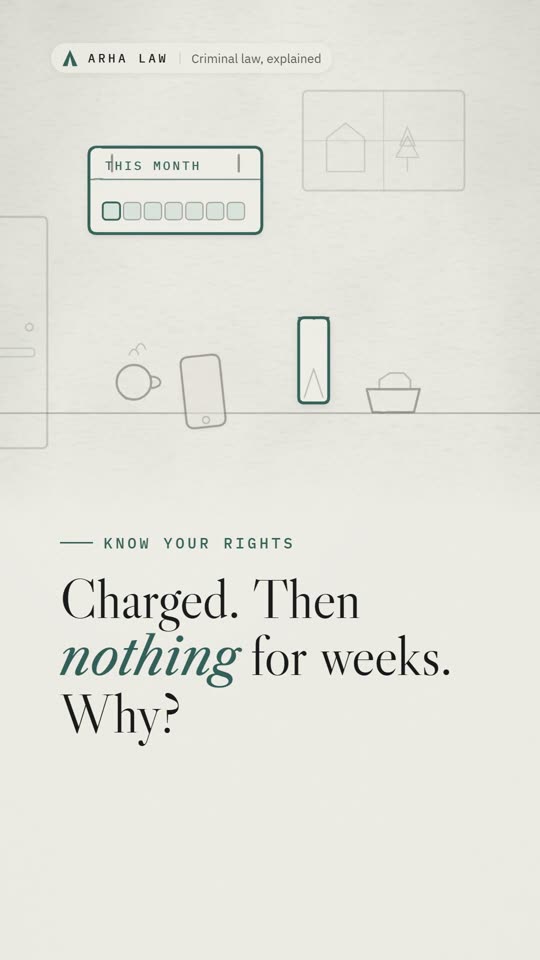
Charged. Then nothing for weeks. Why?
Length 0:29
Charged. Then nothing for weeks. Why?
Know your rights: Charged. Then nothing for weeks. Why?
Disclosure. The Crown handing over its evidence.
The duty: The Crown has to share its evidence with your lawyer. What helps you, not only what hurts.
Why the wait: It can take weeks. The case is adjourned, often about 12 weeks, so your lawyer can review it.
The meeting: By then, your lawyer and the Crown should have talked and be ready to resolve or set a trial date. It's called a Crown pretrial.
What to do: Don't decide on a plea before your lawyer's seen it. Tell your lawyer if you think something's missing.
-
 Length 0:34
Your lawyer met the Crown. Who decides if you plead guilty?
Length 0:34
Your lawyer met the Crown. Who decides if you plead guilty?
The Crown pre-trial: A Crown pre-trial is a meeting. Your lawyer and the Crown discuss your case. They talk about whether it can be resolved.
What to do now
- Tell your lawyer what you want before the Crown pre-trial.
- Decide on a plea only after your lawyer has seen the disclosure.
Where to go from here
- Don't agree to anything, including a plea, before your lawyer has reviewed full disclosure.
- Ask your lawyer to flag anything missing from the disclosure you received.
- Keep a copy of every court date; delays can work for or against you depending on the cause.
People also ask
Do I get to see the evidence against me before I decide how to plead?
Yes. You're entitled to disclosure before you're expected to make any decision about your case.
Can the Crown withhold some evidence?
Only in narrow situations, like protecting an informer's identity or genuinely privileged material, and even then a judge can be asked to review it.
Is a Crown pre-trial the same as a trial?
No. It's a private conversation about the case, not a court hearing, and no evidence is presented.
What happens if my case goes past 18 or 30 months?
Your lawyer can bring an application to have the charge stayed for unreasonable delay, though the Crown can argue exceptional circumstances explain the extra time. For offences since July 18, 2026, a judge must consider other remedies first.
Sources
- [R. v. Stinchcombe, [1991] 3 S.C.R. 326, Supreme Court of Canada](https://decisions.scc-csc.ca/scc-csc/scc-csc/en/item/808/index.do)
- R. v. Jordan, 2016 SCC 27, Supreme Court of Canada
- Criminal Code, s. 492.31, Justice Laws
- Ontario Crown Prosecution Manual, D-10 Disclosure
- Ontario Court of Justice, Judicial Criminal Pre-trial Best Practices
- Legal Aid Ontario, What is a disclosure package?
- Steps to Justice (CLEO), Crown screening form
- Ontario Court of Justice, Step by Step
- Ontario Court of Justice, Jordan-Compliant Trial Scheduling (revised June 1, 2026)
This page is general information about Ontario law as of September 2026. It isn't legal advice about your situation.