What sentence could I get after a guilty plea or finding of guilt?
Sentencing ranges from a discharge with no criminal record to jail, and most cases land well below the maximum penalty. The judge picks based on the offence, your background, and the specific facts, and some offences carry a mandatory minimum that limits the options.
Dealing with this now? Call (416) 305-6019 or request a consultation
On this page
- What is a discharge, and when is it possible?
- What are a suspended sentence, probation, and the victim surcharge?
- What is a conditional sentence, and who can get one?
- How does the judge decide, and how much jail time is realistic?
- Can a sentence affect immigration status?
- What to do next
- Quick questions
What is a discharge, and when is it possible?
An absolute or conditional discharge means the court finds you guilty but doesn't register a conviction. An absolute discharge has no conditions and is removed from the national police database (CPIC) after one year; a conditional discharge comes with up to three years of probation and is removed after three. Discharges aren't available for every offence: under section 730, they can't be used where the offence has a mandatory minimum or is punishable by 14 years or life.
Read what the video says
Will I go to jail?
The honest answer: it depends on what the judge must weigh.
The rule: A sentence must match how serious the offence was and how responsible you were. Judges also weigh goals like deterring crime, protecting the public and rehabilitation.
Worse or better: Facts that make it worse raise the sentence. Facts in your favour can lower it.
The options: Short of jail: a discharge (guilty, not convicted), probation, a fine, or a sentence served at home. Some offences carry a minimum jail term. In rare cases, a judge can now go lower.
Jail comes last: If a lighter sentence would do, you shouldn't be jailed. Judges must consider every other reasonable option. For Indigenous people, judges must also weigh systemic and background factors. This is called Gladue.
The report: The judge can order a pre-sentence report on your background, written by a probation officer. It looks at things like your age, character, attitude and record.
Worth knowing: Probation is the most common sentence. When jail is ordered, it's often short. Not a Canadian citizen? A sentence can affect your immigration status. Talk to an immigration lawyer.
The judge sees the offence. Let them see you, too.
Before sentencing
- Ask your lawyer which options are realistic.
- Letters from people who know you well.
- Proof of work and any counselling.
- Anything that shows the steps you've taken.
What are a suspended sentence, probation, and the victim surcharge?
A suspended sentence means the judge holds off on a specific penalty and releases you on probation instead, with conditions like reporting to a probation officer, counselling, or a curfew, for up to three years. Unlike a discharge, it's a conviction and stays on your record unless you later apply for a record suspension. The victim surcharge, once an automatic add-on, was struck down as unconstitutional in 2018 (R. v. Boudreault); since the 2019 amendments, judges again have discretion to waive or reduce it for undue hardship.
What is a conditional sentence, and who can get one?
A conditional sentence lets you serve a sentence of less than two years in the community, often under strict conditions like house arrest, instead of in jail. Since Bill C-5 took effect in November 2022, more offences became eligible again after earlier restrictions were repealed. Since July 2026, they aren't available for sexual assault or child sexual offences prosecuted by indictment. The judge still has to be satisfied the community won't be put at risk. An intermittent sentence is different: it applies to jail sentences of 90 days or less, served in blocks such as weekends, so you can keep working during the week.
How does the judge decide, and how much jail time is realistic?
Under sections 718 to 718.2, judges weigh several goals at once: denouncing the conduct, deterring the offender and others, protecting the public, and supporting rehabilitation. They look at aggravating factors (abuse of trust, a weapon, planning) and mitigating ones (a guilty plea, no record, genuine remorse), and often order a pre-sentence report. For Indigenous offenders, section 718.2(e) requires the court to consider their background and systemic factors, often through a Gladue report. Jail under two years is served provincially; two years or more goes federal. Some offences carry a minimum jail term. In rare cases a judge can now go lower. Our plea page covers how the decision to plead gets made.
Can a sentence affect immigration status?
Yes, even a light one. Under the Immigration and Refugee Protection Act, a non-citizen can be found inadmissible for "serious criminality" if convicted of an offence with a maximum penalty of 10 years or more, or if a jail sentence of more than six months is imposed. A conditional sentence served in the community doesn't count toward that six months. The test is lower for a foreign national such as a student, worker or visitor: one conviction for a hybrid or indictable offence can be enough on its own. For a permanent resident, a jail term of six months or more can also remove the right to appeal a removal order. Speak to an immigration lawyer if this could apply to you.
Watch more on this topic
-
 Length 1:06
What probation actually requires
Length 1:06
What probation actually requires
Probation isn't nothing.
Here's what it asks of you.
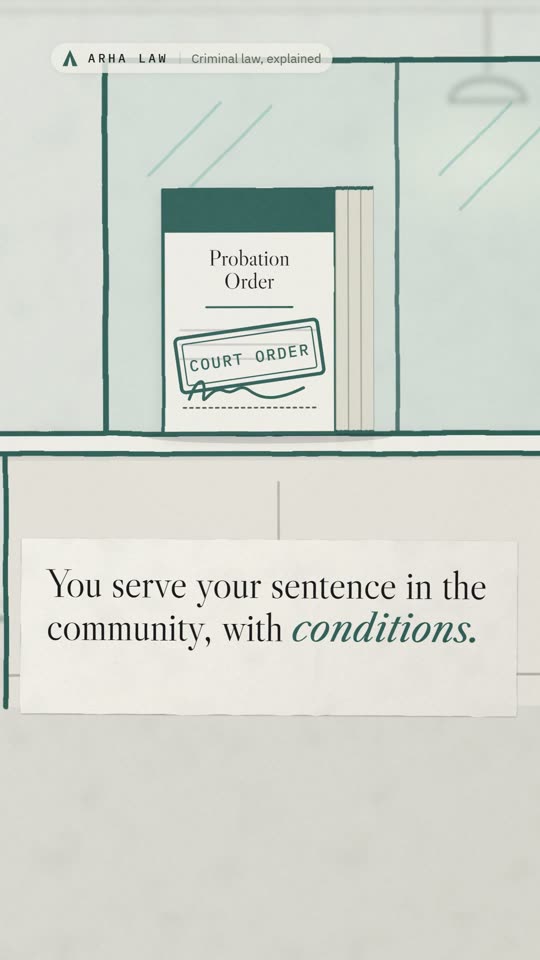
What it is: Probation is a court order. You serve your sentence in the community, with conditions. A judge can order it on its own, or with a fine or jail.
Every order: Every order says: Also: come to court when required, and give notice of a new address or job.
Extra conditions: Orders can add more, like reporting to a probation officer, counselling or community service. Must report? The first report is within two working days, unless the court sets longer.
How long: It can last up to three years. If you're also sent to jail, it starts when you get out.
If you break it: Breaking it without a reasonable excuse is a new crime, with up to four years in jail. On a conditional discharge, a new conviction can turn the discharge into a conviction.
Can't meet a condition?: Some conditions can be changed, or the order shortened, if you apply to the court. Ask before you break it, not after.
Your officer can also point you to help.
Living with it
- Read every condition, and keep your copy.
- If you must report, be on time, every time.
- Tell the court or your officer before you move.
- Can't keep a condition? Talk to a lawyer about changing it.
-
 Length 1:03
Four ways a criminal case can end
Length 1:03
Four ways a criminal case can end
Four ways a case can end.
Only one is a conviction.
Withdrawn or stayed: The Crown can withdraw the charge, or stop the case with a stay. Neither is a finding of guilt. A stayed case can restart within a year. After that, it's treated as never started.
Through diversion: Diversion lets some people deal with a charge outside court. Finish it fully, and the charge must be dismissed. You must accept responsibility. What you say to get in can't be used against you.
Peace bond: A peace bond is a court order to keep the peace, for up to 12 months. Not a conviction. Breaking it is a crime. It can show on some deeper police checks.
Discharge: A discharge means you're found guilty, but the law treats you as not convicted. Federal records are sealed after 1 year, or 3 if it's conditional. No application needed.
Conviction: A conviction stays on your criminal record unless you later get a record suspension. It's never automatic. You apply to the Parole Board, and it decides.
Who decides: Which door opens depends on your case, the Crown and the court. No one can promise one. A discharge isn't possible with a minimum penalty. Partner cases: peace bonds only in exceptional cases.
Charged isn't convicted. How it ends still matters.
What to do
- Ask your lawyer which endings are possible for you.
- Know every condition before you agree to anything.
- Follow each condition until it ends.
- No conviction? Ask police to destroy your prints and photos.
-
 Length 0:30
Myth: "First offence, nothing happens"
Length 0:30
Myth: "First offence, nothing happens"
Myth or fact: “First offence, nothing happens.”
Myth. A first offence matters. It doesn't erase the charge.
Same process: A first charge goes through the same process as any other. Diversion isn't automatic for first offenders.
For example: First impaired driving conviction: at least a $1,000 fine and at least a one-year driving ban. No discharge is possible. A conviction means a criminal record.
Where it helps: Having no record can count in your favour at sentencing. A pre-sentence report lists any past findings of guilt or diversion.
What to do: Treat a first charge seriously. Get advice before your first court date.
-
 Length 1:03
Not a citizen? Your sentence can cost you your status
Length 1:03
Not a citizen? Your sentence can cost you your status
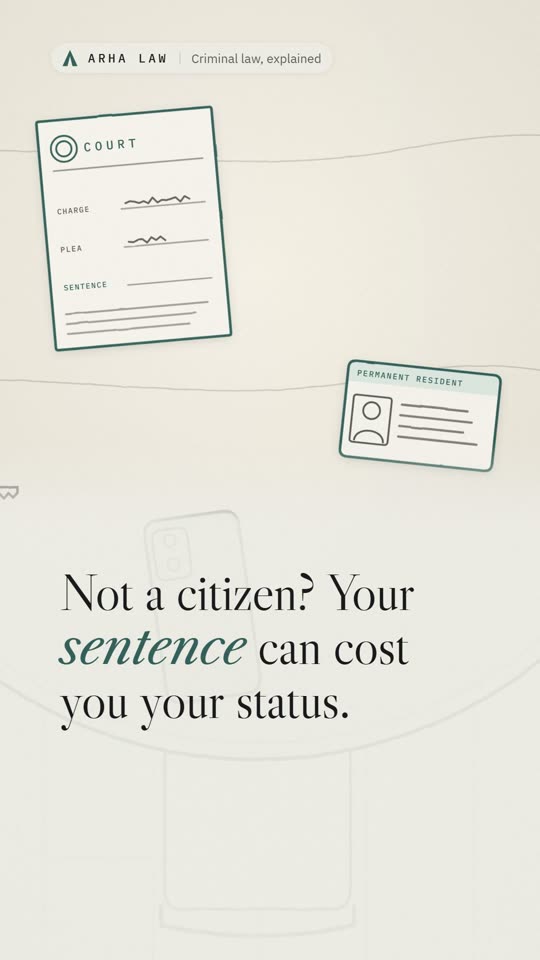
Not a citizen? Your sentence can cost you your status.
It's not the charge. It's the conviction, and the sentence, that count.
Who this is for: This is for permanent residents, students, workers and visitors. Not citizens. Citizens can't lose their status over a crime.
What counts: A conviction, plus the sentence a judge gives you. A 10-year maximum, or more than six months in jail.
The appeal: Six months or more in jail can also take away a permanent resident's appeal. No chance to ask to stay for family or hardship.
A lower bar: Students, workers and visitors face a lower bar. One conviction can be enough. Even a lesser hybrid charge counts as indictable.
Before you decide: A discharge isn't a conviction. But don't count on that without advice. A judge can weigh your status at sentencing. The sentence still has to fit the crime.
There's no promise either way. Only a choice to ask before you decide.
What to do
- Tell your criminal lawyer you're not a citizen, on day one.
- See an immigration lawyer before you plead.
- Don't sign anything about your status without advice.
- Keep every paper the court gives you.
-
 Length 0:34
Got probation? Did you get off?
Length 0:34
Got probation? Did you get off?
How long: It can last up to three years. If you also serve jail time, it starts when you get out.
What to do now
- Read every condition on your copy.
- Can’t keep one? Ask a lawyer about changing it.
Where to go from here
- Ask your lawyer which sentencing options are realistic for your charge before you decide how to proceed.
- Gather references, proof of employment, or counselling records; they can support a lighter sentence.
- If a discharge is possible, ask how it affects your record compared to other options.
People also ask
Does a conditional discharge show up on a background check?
It can show up on some checks while it's within its disclosure period. See our criminal records page for details.
Can I still travel with a discharge?
Some countries, including the United States, can treat a discharge as relevant even though it isn't a conviction here. Ask your lawyer before you travel.
Do I need a lawyer for sentencing if I'm pleading guilty?
You don't have to have one, but a lawyer can present mitigating facts that can meaningfully change the outcome.
Sources
- Criminal Code, s. 730, Justice Laws
- Criminal Code, s. 731, Justice Laws
- Criminal Code, s. 732, Justice Laws
- Criminal Code, s. 742.1, Justice Laws
- Criminal Code, s. 718.4, Justice Laws
- R. v. Boudreault, 2018 SCC 58, Supreme Court of Canada
- Bill C-5 (S.C. 2022, c. 15), LEGISinfo, Royal Assent November 17, 2022
- Department of Justice Canada, Bill C-5 Policy Q&A
- Department of Justice Canada, Spotlight on Gladue
- Immigration and Refugee Protection Act, s. 36, Justice Laws
- Immigration and Refugee Protection Act, s. 64, Justice Laws
- Tran v. Canada (Public Safety and Emergency Preparedness), 2017 SCC 50, Supreme Court of Canada
This page is general information about Ontario law as of September 2026. It isn't legal advice about your situation.