Charged with breach or failing to comply in Ontario
These charges come from breaking a condition a court already set, like missing a curfew or contacting someone you were told not to. They're common and often start as a small slip-up rather than a new crime. Since 2019, many minor breaches can go to a review hearing instead of a fresh charge.
Dealing with this now? Call (416) 305-6019 or request a consultation
On this page
What counts as a breach charge?
This group covers breaking rules a court already imposed, not a new crime. The main versions: failing to comply with a release order, like a curfew or no-contact term; breach of probation, such as skipping check-ins with a probation officer; failing to appear for a scheduled court date; and obstruction, interfering with police, including giving a false name.
Read what the video says
Out on bail, with a page of rules.
One slip can put you back inside.
What counts: Break any condition and it's a breach, even if what you did is legal. Forgetting or misunderstanding a condition usually isn't enough on its own.
A new charge: A breach is a new charge, on top of the one you already face. No harm, damage or loss? The Crown may choose a bail hearing over a new charge.
Your release: Arrested for a breach? A judge can cancel your bail.
The burden flips: Charged with a breach? At the next bail hearing, you usually must show why you should be released. If your bail was cancelled, your plan must clearly show it deals with the risks.
Changing a condition: You, the Crown and every surety can agree to a change in writing. No agreement? You can ask a judge to review your bail.
Change it before you break it. Not after.
What to do
- Read every condition. Ask about anything unclear.
- Set reminders for curfew and reporting times.
- Need a change? Ask a lawyer before you act.
- Slipped up? Get legal advice the same day.
What does the Crown have to prove?
The Crown must show you knew about the condition and broke it without a lawful excuse. A lawful excuse is narrow, for example a documented medical emergency that made court impossible. Forgetting or misunderstanding a condition usually isn't enough on its own, though it can shape how the case is handled.
Can a breach skip a new charge?
Since December 2019, police and the Crown can send some minor breaches to a hearing where a judge reviews your existing bail conditions instead of laying a new charge. The judge can leave conditions alone, change them, or detain you, without a separate breach conviction. Not every situation qualifies, and the Crown can still choose to charge instead.
What are the possible outcomes?
A failing-to-comply charge can go through the faster process or the more serious one, which carries up to 2 years. There's no mandatory minimum. A new breach while already on bail can make release harder to get again, since it suggests broken trust. It also doesn't automatically make your original charge worse, but it complicates bail, sometimes meaning a new hearing with a stricter surety (someone who supervises you and pledges money to the court) or tighter terms.
Watch more on this topic
-
 Length 0:31
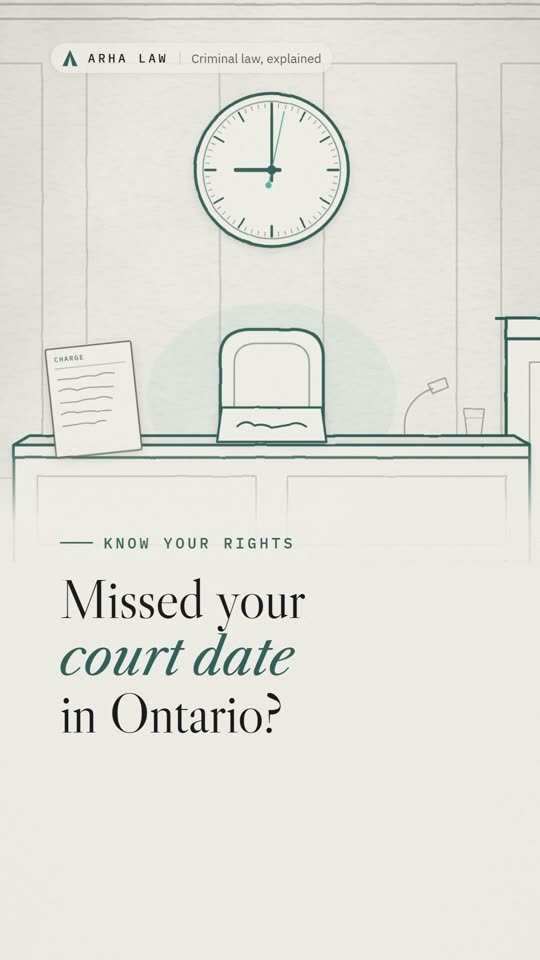
Missed your court date?
Length 0:31
Missed your court date?
Know your rights: Missed your court date in Ontario?
Act today. Don't wait to be arrested.
A new charge: Missing court is its own crime, on top of your original charge. Up to two years. Missing a fingerprint date is a crime too.
A warrant: A judge can issue a warrant for your arrest. It can be used anywhere in Ontario.
Your bail: Your bail can be cancelled. Then it's on you to show why you should be released. Since July 15, 2026, you must clearly show your release plan addresses the risks.
What to do: Call your lawyer, or the court office, right away. A lawful excuse can be a defence.
Where to go from here
- Read your release or probation terms closely and ask about anything unclear before you break it by accident.
- If you've already missed a condition, get advice quickly rather than waiting for police to call.
- Keep proof of anything that made compliance impossible, like a medical note or messages to your surety.
- Don't assume a late arrival gets ignored. Call your lawyer the same day you realize you've breached.
People also ask
Can I go to jail for missing a curfew by a few minutes?
It's possible but not automatic. Courts often use discretion for minor, unintentional breaches, especially a first one.
Does a breach charge affect my original charge?
Not directly, but it can affect your bail and how the Crown views you going forward.
What if I breached because of something outside my control?
That may support a lawful excuse defence. Document it and raise it with your lawyer right away.
Is failing to appear the same as a breach?
It's related but separate, tied specifically to missing a required court date.
Sources
- https://laws-lois.justice.gc.ca/eng/acts/c-46/section-145.html
- https://laws-lois.justice.gc.ca/eng/acts/C-46/section-523.1.html
- https://www.ppsc-sppc.gc.ca/eng/pub/fpsd-sfpg/fps-sfp/tpd/p3/ch20.html
This page is general information about Ontario law as of September 2026. It isn't legal advice about your situation.